What can an old house tell you before you can read any of its labels? At Fukushima City Minka-en, start with the roof, then look at the floor and the objects inside. The open-air museum brings historic buildings together in a park, giving you a concrete way to picture everyday work and home life in earlier Fukushima.
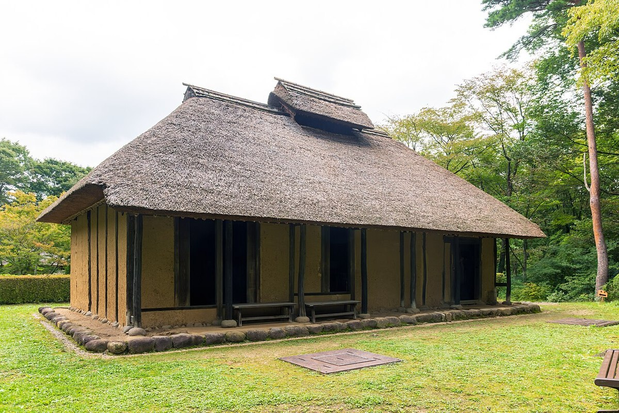

Old buildings, brought together for visitors
Minka-en is inside Azuma Sports Park in Fukushima City. The city describes houses, a merchant inn, a restaurant, storehouses and a theatre relocated and restored with gardens and fields around them. Most come from northern Fukushima, with an example from the Aizu region too. These are preserved buildings in a museum setting, rather than a residential village you are walking through. See the city’s museum introduction.
You do not need to identify every architectural style to enjoy a visit. Pick one building and ask three ordinary questions: where did people spend time, where did they work, and what helped them prepare food?
Look from the roof down to the floor
The Former Abe Family House in the photograph has a broad thatched roof extending beyond its walls. Start with that large shape, then notice the timber posts and the doorway. Look at how far the roof projects over the entrance.
JNTO’s museum guide points visitors towards thatched roofs, wooden pillars, tatami floors and irori, hearths set into the floor. The buildings do not all have identical layouts. Look for these features where they actually appear instead of expecting one model of “the Japanese house.” Read the guide to the museum’s architecture.
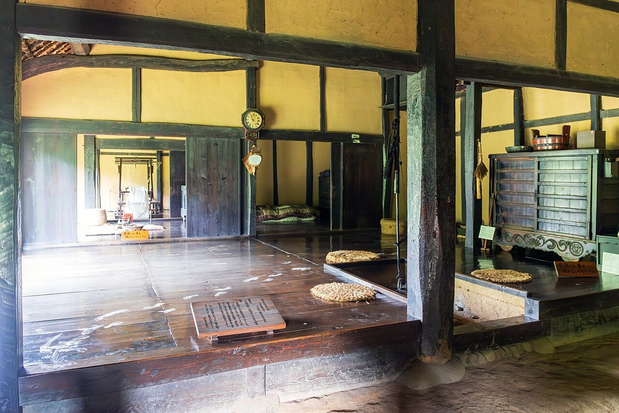

In this photograph of the Former Narawa Family House, the raised wooden floor, dark beams and round woven seats make the room easier to imagine. Notice the difference in height between the foreground and the room beyond. Follow the museum’s signs about where you may enter and whether to remove shoes.
Let one household object start a question
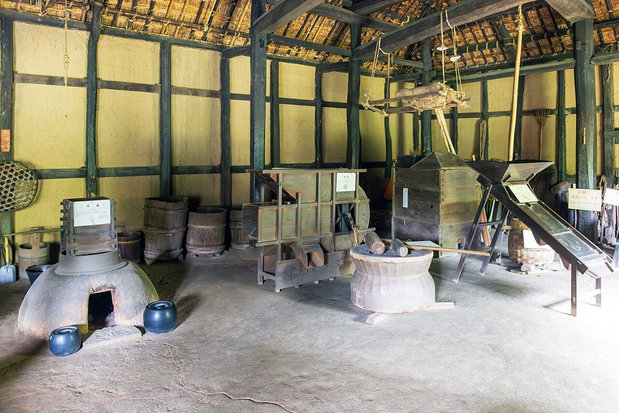

This photograph shows the same house’s display of household and work objects. A cooking hearth, wooden containers and a large mortar occupy a room together. Look at their size in relation to the doorway and floor.
You might ask how a heavy vessel was moved, or where someone would stand to work. The photograph cannot answer every question. Use the labels or ask staff for an object’s name and purpose, rather than guessing from its shape. Children can try a simple observation game too: find something made of wood, something woven and something used near a fire. Observe the displays without treating them as play equipment.
Plan around the open buildings
Checked 14 September 2026: the museum lists free admission and opening hours of 09:00–16:30. It normally closes on Tuesdays, moving the closure to the next weekday when Tuesday is a public holiday, and from 29 December to 3 January. Check the museum’s current notices before travelling.
The Former Hirose-za Theatre is currently unavailable for viewing while reopening preparations continue. The museum says reopening is planned for November; that is a plan, not a confirmed promise that it will be accessible on a particular visit. The other buildings are the focus of this introduction. Read the theatre notice.
The city’s access guide places the nearest bus stop at Muroishi, about 15 minutes away on foot. Check both outward and return services before leaving Fukushima Station. For current route links and parking information, use the official access guide.
A visit can begin with something as simple as a doorway. Look through it slowly, and the museum becomes a place to notice how a home worked.