Fukushima City is the inland capital of Fukushima Prefecture, in northeastern Japan. The Fukushima Daiichi Nuclear Power Station is a different place, on the prefecture’s Pacific coast. Understanding those names makes it easier to understand the place I call home.
I’m Ryo. I live in Fukushima City with my family of four, including our two daughters. Food, exploring shops, visiting shrines, and finding places for children to play are among my interests. Small Stops Japan begins with those everyday interests, here and elsewhere in Japan.
One name, three different meanings
When you read “Fukushima,” check which place the writer means:
- Fukushima Prefecture (福島県) is the wider administrative region. It includes many cities and towns, stretching from inland mountains to the Pacific coast.
- Fukushima City (福島市) is its capital city. This is where I live.
- Fukushima Daiichi (福島第一原子力発電所) is the nuclear power station associated with the 2011 accident. Its site spans the coastal towns of Okuma and Futaba.
The prefecture is commonly divided into three regions: Aizu, Nakadori, and Hamadori. Their landscapes and local conditions differ. A story about one location should not automatically be read as a description of the entire prefecture. See the prefecture’s regional overview and the IAEA’s description of the power station’s location.
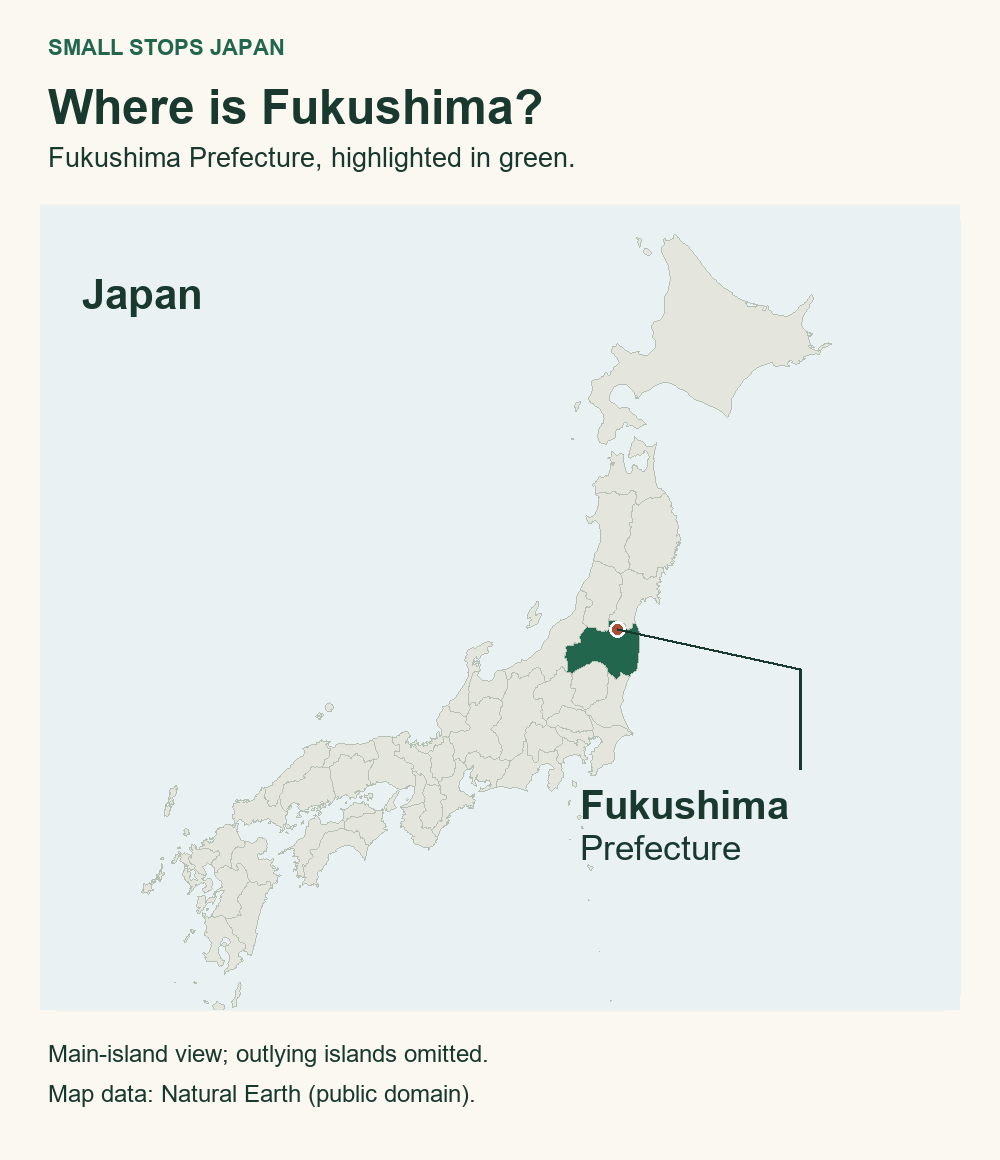
How far is the city from Fukushima Daiichi?
Using Fukushima City Hall as a reference point, the power station is roughly 60 kilometres (37 miles) away in a straight line, to the southeast. This is an approximate geographic comparison, not a driving distance or a distance from my home.
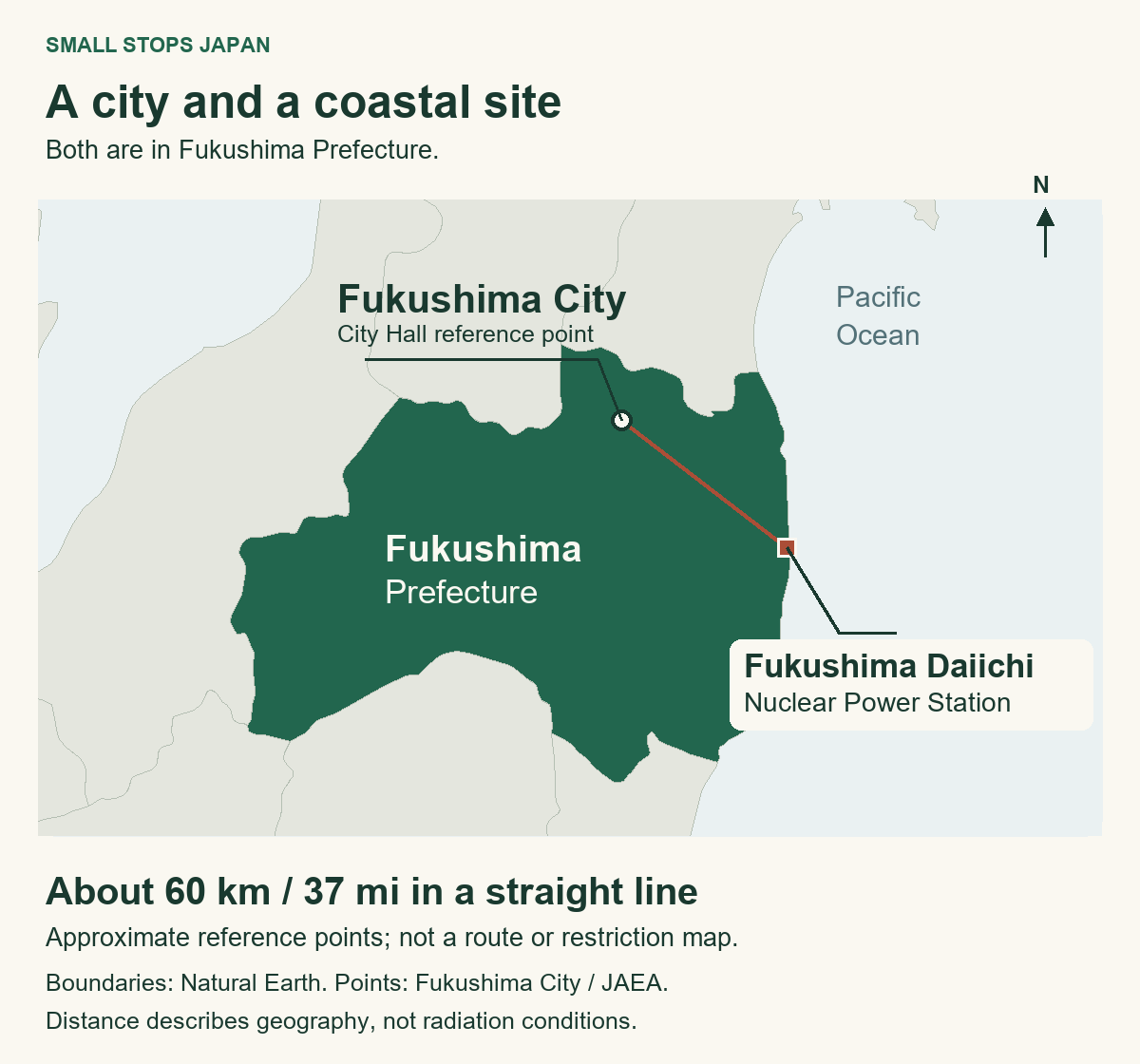
The estimate uses the city hall coordinates published by Fukushima City and the approximate plant coordinates in a Japan Atomic Energy Agency report. The points and prefectural boundary are simplified for orientation.
Distance helps explain the map. It does not, by itself, tell you about radiation conditions, access restrictions, or the experience of people in a particular community.
What does Fukushima City mean to me?
For my family, Fukushima City is home and the setting for ordinary daily life. That is the perspective I want to share: the food that catches our attention, the shops and shrines we are interested in, and places to spend time as a family.
My experience in the city is one perspective. It cannot stand in for every family or community across Fukushima Prefecture, including people whose lives were changed by the disaster.
If you are beginning to explore the city from afar, these are three useful starting points:
- Fruit: the city is known for its fruit, including peaches. Learning about local produce is one way into its food culture.
- Enban gyoza: these pan-fried dumplings are arranged in a circle and served as a disc. The city tourism association’s guide introduces this local dish.
- Hot-spring areas: Iizaka, Takayu, and Tsuchiyu are all part of the city’s introduction to visitors. They also show why a city name can cover more than its central streets.
The official city introduction is a useful starting point for fruit and hot springs. These are background examples, rather than reviews of places I have personally visited.
Where to check information about the disaster and recovery
The 2011 disaster and its consequences are part of Fukushima’s story. For information about recovery, evacuation areas, and current conditions, use the Fukushima Prefectural Government’s English information portal. Check the date and the specific place covered by each update, especially if you are planning a visit.
Here at Small Stops Japan, I want to make room for the everyday details too. Knowing where Fukushima City is gives those stories a place on the map.
By Ryo · Geographic references checked 12 September 2026. Map boundaries: Natural Earth, public domain. Maps prepared for Small Stops Japan.
Maps: Small Stops Japan. Base map data: Natural Earth (public domain). Image-use notes.