A bus is usually something you catch before it leaves. At Fukushima’s bus festival, stopping to look is the point. If you are curious about the vehicles you see around town—or traveling with someone who notices every bus—this is a small outing to consider in central Fukushima City.
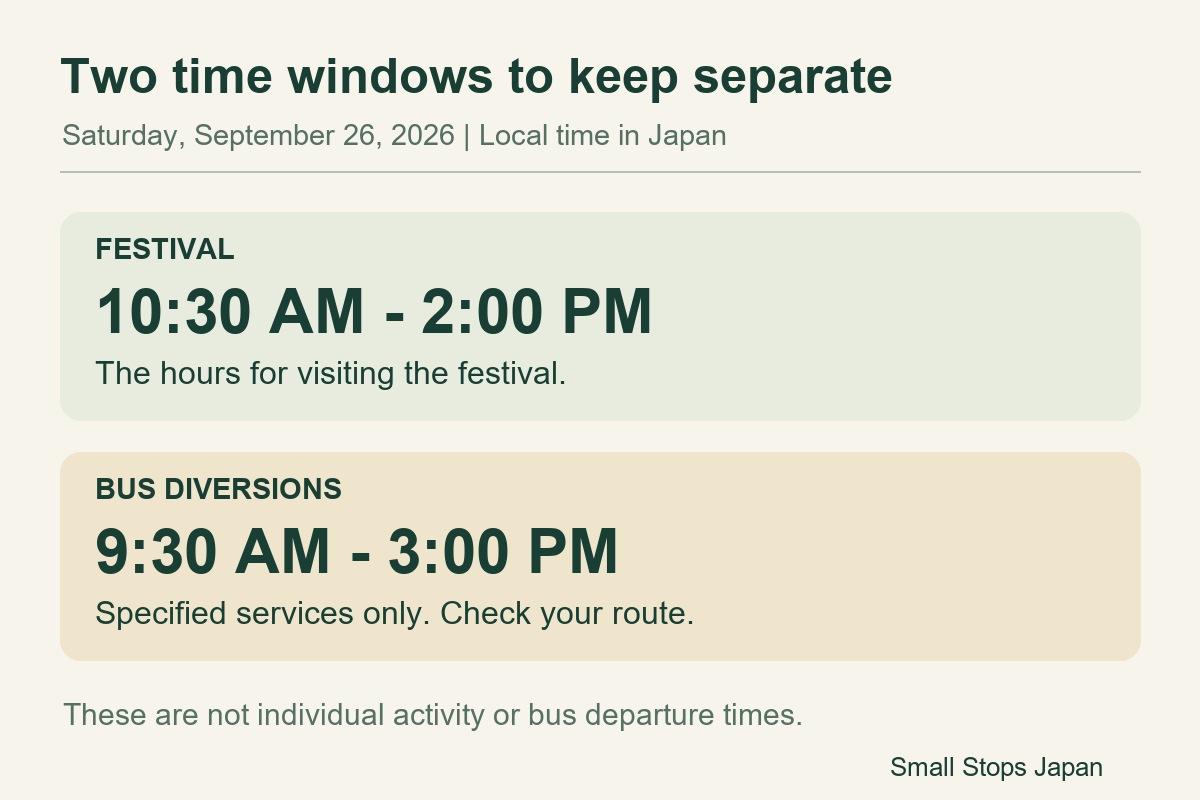
The 16th Fukushima Bus Festival is scheduled for Saturday, September 26, 2026, from 10:30 a.m. to 2 p.m. Its two venues are Fukushima Ekimae-dori (the street in front of Fukushima Station) and Machinaka Hiroba, according to Fukushima City’s announcement. These are the festival hours, not the longer traffic-restriction hours.
Start with the practical details
The city tourism association’s event listing says admission is free, with the event going ahead in rain but canceled in severe weather. It lists no event parking and recommends public transport or nearby paid parking. Free admission does not mean merchandise or every activity is free.
The announcements checked for this guide do not list a general advance-booking requirement for entry. Individual activities can have their own limits and tickets, so a free festival is not a promise that you can join everything on arrival.
This is Fukushima City, where I live. If you are still placing it on your mental map, our introduction to Fukushima City is a useful starting point. The Japanese name to recognize on local notices is 福島バスまつり—Fukushima Bus Matsuri.
Two venues, two ways to enjoy it
The organizer’s announcement and linked flyer divide the outing between the station-front street and Machinaka Hiroba. You do not need to learn bus model names before you go. Looking at how their shapes, doors, and uses differ is a perfectly good place to start.
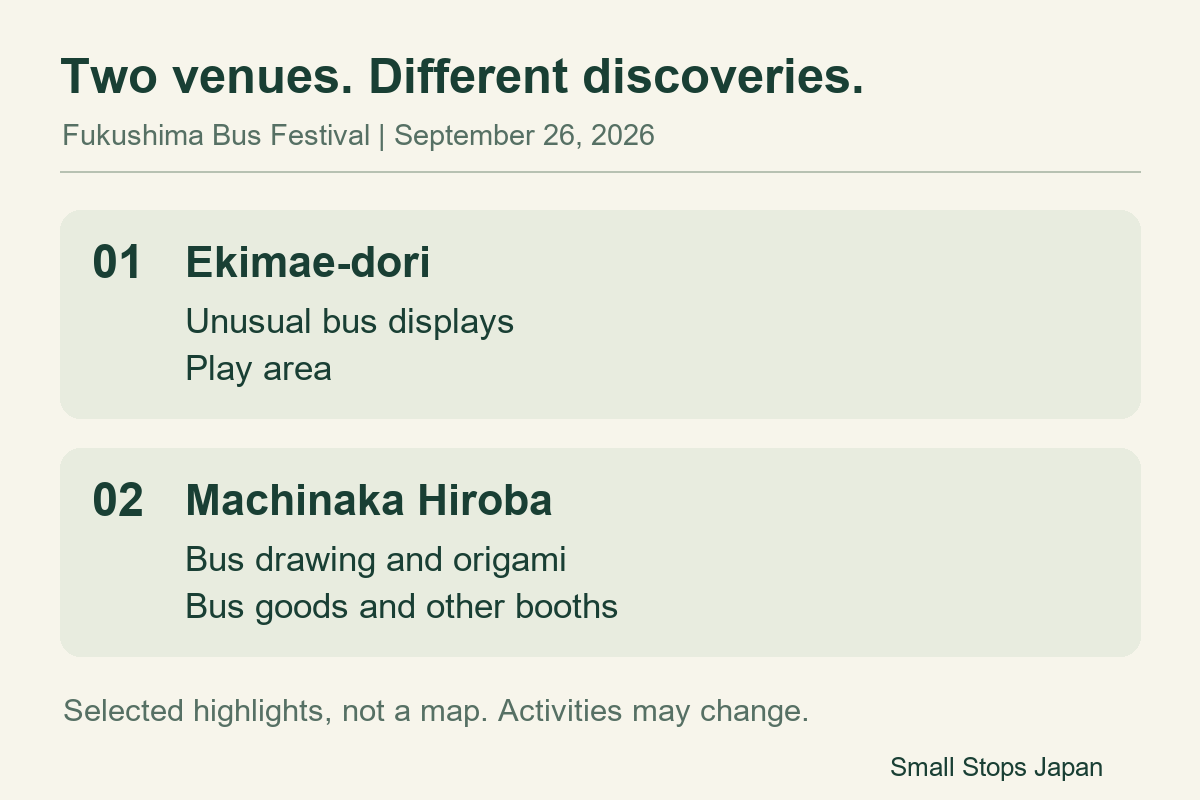
At Ekimae-dori, the flyer places unusual bus displays and a play area. At Machinaka Hiroba, it lists the bus-drawing activity, an origami corner, goods sales, and other booths. The diagram below groups those highlights; it is not a walking map or a complete program.
For a closer look at the vehicles, Fukushima Kotsu’s exhibitor announcement lists a double-decker overnight bus, Aizu-Wakamatsu’s Haikara-san sightseeing bus, a retro bus, and two Chansey-wrapped buses on Ekimae-dori. Its blue Melody Bus is listed at Machinaka Hiroba. These are announced displays, not a guarantee of rides.
That mix is what makes the event interesting to me: vehicles for different kinds of journeys, gathered where you can compare them. Rather than try to see every booth, I would choose one or two things that catch your attention and leave room to wander.
Check the time for the activity you want
The organizer’s flyer gives 10:45 a.m. and noon as the starts for the bus-drawing sessions. It says the activity ends when drawing space runs out. The origami corner also ends when its supplies are gone; do not assume either runs continuously until closing.
There is another distinction for Pokémon fans. Fukushima Kotsu says the Chansey photo greetings have limited places, with numbered tickets for both sessions distributed from 10:30 a.m. Seeing a wrapped bus and getting a greeting ticket are different plans. Follow the organizer’s linked greeting information and staff instructions for the current details.
Getting there without a last-minute surprise
Fukushima Kotsu’s September 26 diversion notice covers 9:30 a.m. to 3 p.m. It affects specified Higashihama-cho services and Melody Bus departures and lists the Ekimae-dori stop as suspended. The same notice says there are no suspended Melody Bus stops. Check your particular service; this is not a closure of every bus route around the station.
If you are driving, the city links to its park-and-ride scheme. Read its parking location, operating hours, reception procedure, and per-person charges before using it. It is a separate service, not free parking beside the displays.
One check before you set off
Information checked September 20, 2026. Reopen the organizer’s notice before traveling for changes or cancellation. The organizer also asks visitors to prepare for heat; take water and plan breaks according to the conditions that day.
I would treat this as a chance to notice something ordinary a little more closely. A familiar street vehicle can have an unexpected shape, history, or job. You do not have to become a bus enthusiast to enjoy finding one detail you had never noticed.
Image credits: Small Stops Japan. Image-use notes.