Your meal has arrived, and you want to put your chopsticks down to take a drink. There is a small ceramic object in front of you. It might look like a tiny ornament, but it has a practical job.
It is a hashioki (箸置き), or chopstick rest. Set the pair together across it, supporting the narrow ends while leaving a little of each tip extending beyond the rest. You now have somewhere to put them between mouthfuls.
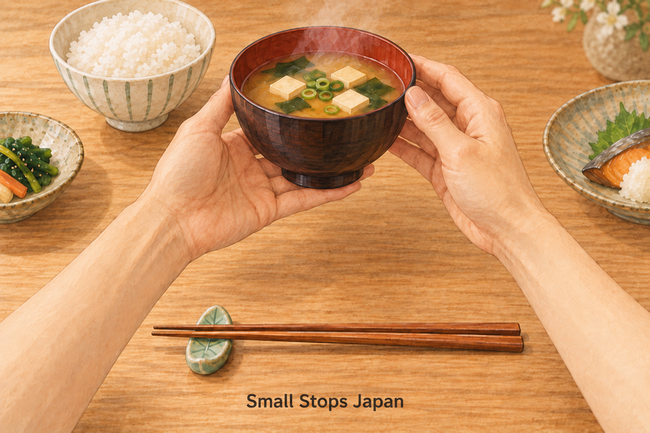
Find the small rest before you start
Look near the chopsticks at your own place setting. In the conventional arrangement described in the Ministry of Foreign Affairs’ niponica guide to hashioki, the pair lies across the front of the meal, parallel to the table edge, with the rest on the diner’s left.
The same guide shows how something so small can add a seasonal detail to the table. A rest can be both useful and decorative; its appearance does not have to resemble the green one in our illustration.
If you are unsure whether a small object is a rest or part of the decoration, ask before moving it. “Is this for the chopsticks?” is a perfectly useful question. There is no need to rearrange the whole table to match a diagram.
Let the tips extend beyond it
Bring the two chopsticks together and lower them onto the rest. The support goes a short distance back from the eating tips, rather than directly under their very ends. The ministry’s guide suggests an overhang of about 3 cm, a little over an inch.
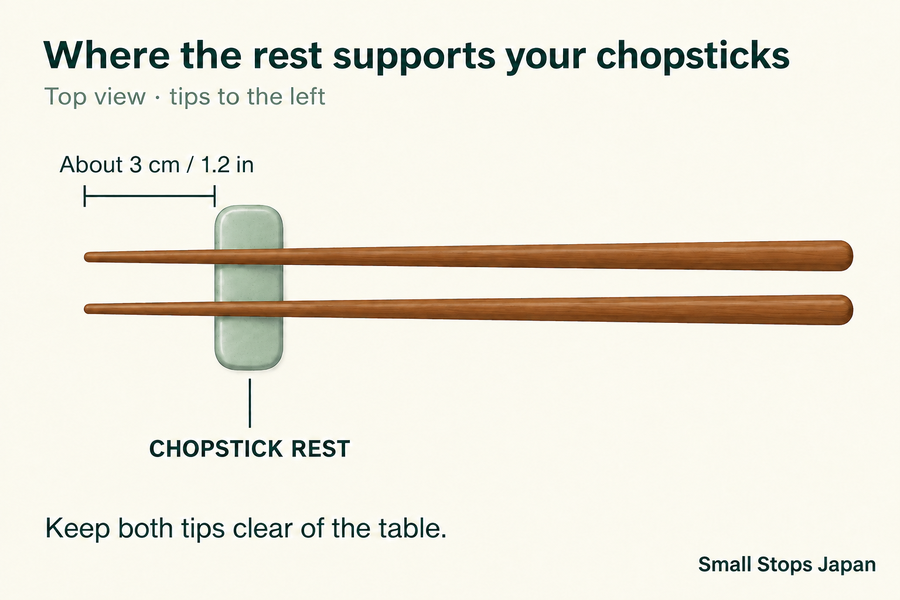
You do not need to measure this at dinner. Look for a stable position: both sticks supported, their tips clear of the table, and the pair easy to pick up again. If one rolls away, bring it back alongside the other and adjust the pair gently.
The movement is small. Try setting them down once before eating, when you can look at the rest without also balancing a bowl or deciding what to take next.
A pause for soup or a drink
This is a useful place to leave the pair when you want your hands free. For example, Japan’s Ministry of Agriculture, Forestry and Fisheries notes in its guide to chopstick use that you can leave chopsticks on the rest while drinking just the broth from a soup bowl.
Its separate table-manners guidance lists laying chopsticks across a dish during a meal as watashibashi, an action to avoid. When a rest is provided, use that place for your pause.
If you cannot find one, ask where to put your chopsticks. The useful habit is to notice the arrangement you have been given, rather than assume that every meal comes with the same accessories.
A detail you can notice at the next meal
Next time a tray arrives, look at the space in front of the bowls as well as the food. Find where the chopsticks are resting and notice how the little support works with their shape.
You can enjoy its colour or form without knowing its maker, age, or regional origin. Those details need their own evidence. For your first meal with a hashioki, recognising its job and finding a comfortable place to pause is enough.
Illustrations: Small Stops Japan. Image-use notes.