A wooden shelf holds bags of tomatoes, bundles of asparagus, and handwritten price cards. You can see what is for sale, but there is no checkout counter. Where does the money go?
I took these photographs in Fukushima City. They show two ways of selling produce without a cashier: an open shelf with a payment box, and a vending machine with individual locker doors. At the shelf, you check the price and quantity, then put the payment in the designated box. At the locker, you pay through the machine before opening the compartment you have chosen.
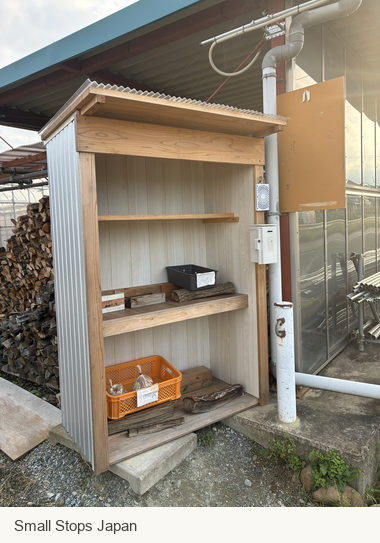
The Japanese term 無人販売所 (mujin hanbaijo) means an unattended sales stand. If you know an honour-system farm stand, the open-shelf arrangement may feel familiar. A USDA farmer profile describes a grower in North Carolina who began selling that way, too. Here, the useful details to learn are the Japanese signs and the payment setup in front of you.
Read what the price is for
A large 100円 tells you the price is 100 yen. The smaller writing beside it can tell you how much produce that buys.
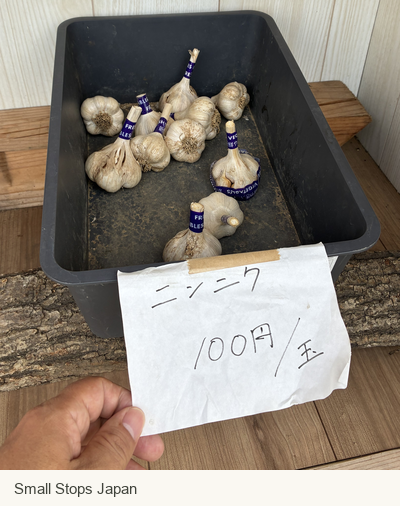
In the garlic photograph, ニンニク 100円/玉 means garlic at 100 yen per bulb. That is one whole bulb, rather than one of the cloves inside it. Two bulbs at that displayed price would total 200 yen.
The front label in the asparagus close-up shows 100円/束: 100 yen per bundle. A separate bundle at the upper right has a 300-yen label, so check the label attached to the produce you choose. The large sign in front of the bagged tomatoes says 300円/袋: 300 yen per bag. Look at the bundle or bag as it is offered, rather than counting every stalk or tomato as a separate purchase.
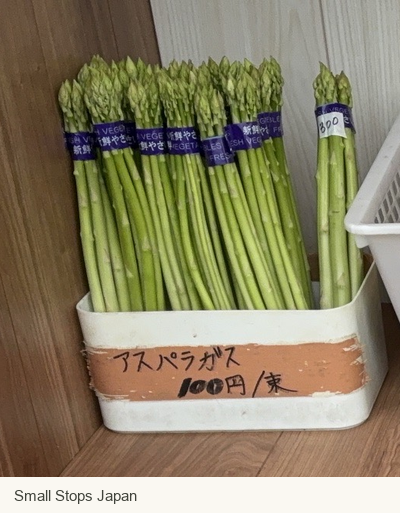
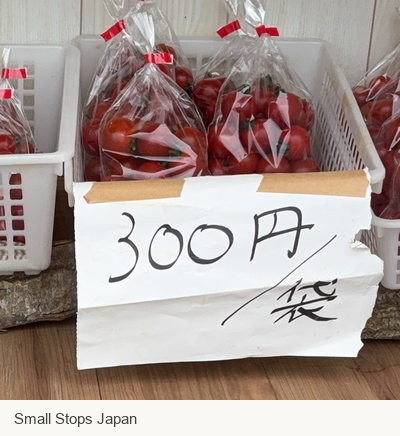
These are the prices visible when the photographs were taken. They illustrate how to read a label; they are not a current price list. When several baskets sit close together, match each sign to its product before adding up your payment.
Find the payment box before you leave
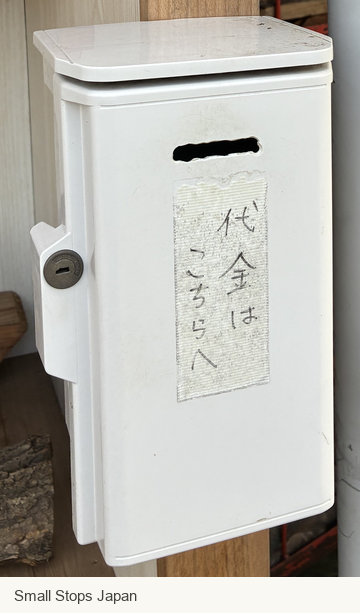
The white box beside the shelf has a slot and the words 代金はこちらへ—“Payment here.” This is the place to put the money for the produce you choose.
At an open stand like this, first check the item, its selling unit, and the displayed amount. Work out the total, follow the payment instructions, and leave the full payment in the designated box before taking your purchase away.
It helps to bring coins so you can make an exact payment. Change and payment methods depend on the seller. For example, Ando Shunsaien’s own unattended stand in Fukushima City states that it accepts cash and does not provide change. That is a separate published example, not an identification of the stand in my photographs. Check the instructions wherever you shop.
With a locker, pay at the compartment
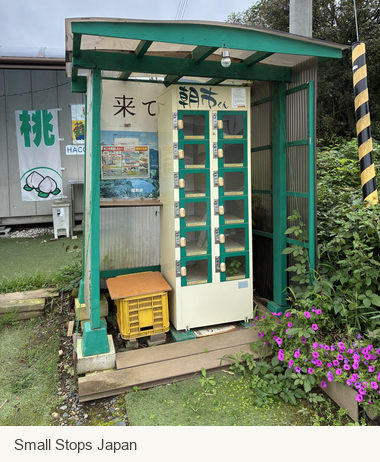
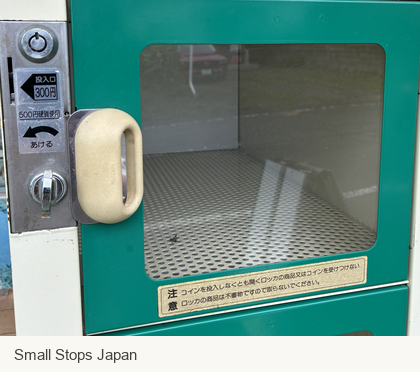
The green machine shows the other arrangement: windows let you look inside individual compartments, with a coin slot and opening controls alongside the door. You receive the contents by opening the compartment after paying, rather than picking a bag from an open shelf and using a separate payment box.
Choose a compartment with the produce you want, then check its price, accepted coins, and operating instructions before inserting money. Follow that compartment’s instructions to pay, open the door, and collect the contents. An empty compartment offers nothing to buy, even if a price label remains beside it.
The machine in the photograph also carries a notice telling customers not to take items from compartments that open without payment or will not accept coins. An unexpectedly open door is not an invitation to take something for free. If the payment instructions are unclear, ask the seller where contact details are provided, or leave that purchase for another time.
Produce lockers are part of the local scene: a 2023 feature by Fukushima City’s tourism association introduces examples selling fruit and vegetables. Its older prices and opening hours should not be treated as today’s instructions for another machine.
Let the day’s display guide you
These small selling places can offer fruit as well as vegetables, and what is available changes. Ando Shunsaien explains that its selection varies with the season, weather, and harvest. The photographs here capture particular displays, rather than a stock forecast for your visit.
What makes the scene worth a closer look is how much a small sign can explain. A bulb, a bundle, a bag—and a place to pay. Once those details are clear, a shelf with no cashier becomes much easier to understand.
For the broader setting, see our introduction to Fukushima City.
Photographs: Small Stops Japan. Image-use notes.