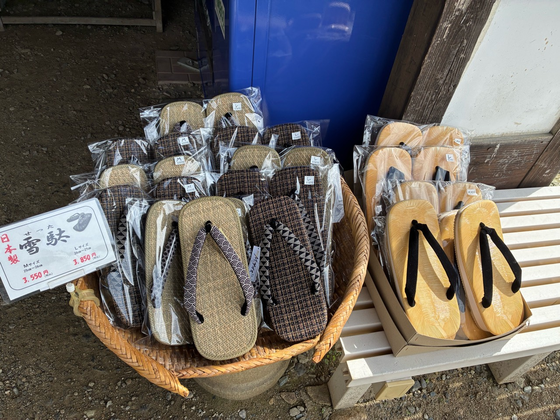
A basket of sandals and a row of wooden footwear can look like variations on the same idea: a surface for your foot, with straps rising from it. These photographs from Ouchi-juku, in Fukushima, give us a closer view. The basket on the left is labelled setta (雪駄); another display carries the name Aizu kiri geta (会津桐下駄).
The straps are a useful starting point. Then look at what they are attached to. That small change of focus takes us from patterns and colours to the way the footwear is built.
The part they share: hanao
In the basket photograph, some straps have small repeating patterns, while others stand out against darker woven-looking surfaces. The familiar shape helps explain why these different pairs seem related.
These straps are called hanao. The name belongs to a component used on several kinds of Japanese footwear, including setta, geta and zori, another family of thong sandals. Adachi City’s introduction to hanao describes this shared role. A patterned hanao can catch your eye without telling you the name of the whole sandal.
Follow the straps to the base
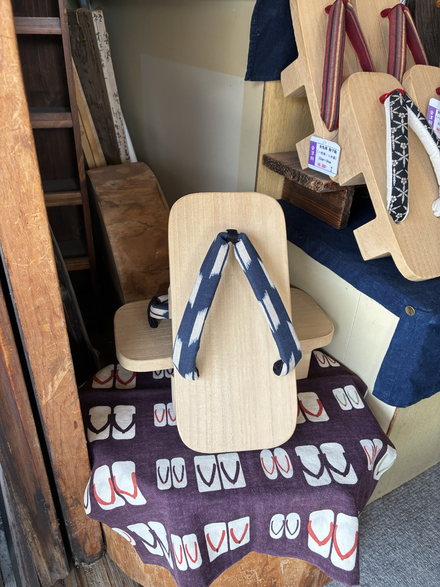
The close view of the pale wooden geta makes the arrangement easier to follow. Start at the small front connection of the blue-and-white straps, then trace the two sides back to where they meet the wood. The foot rests on the broad surface between them.
The wooden base is called the dai. A museum description of geta explains that the hanao is fitted through three holes in the base. The photograph lets us follow the visible connections; the underside fastening remains out of view. Chiba Prefectural Central Museum, Otone Branch
Notice the outline, too. The foreground base has a broad, rounded rectangular shape. Behind it are other outlines and strap patterns. Once you separate the straps from the base in your mind, there are two designs to look at rather than one.
The side view reveals the teeth
The illustration below isolates a two-tooth geta so that nothing hides its side profile. Follow the horizontal platform, then the two wooden supports down to where they touch the ground. The open gap between them makes the raised structure easy to see.
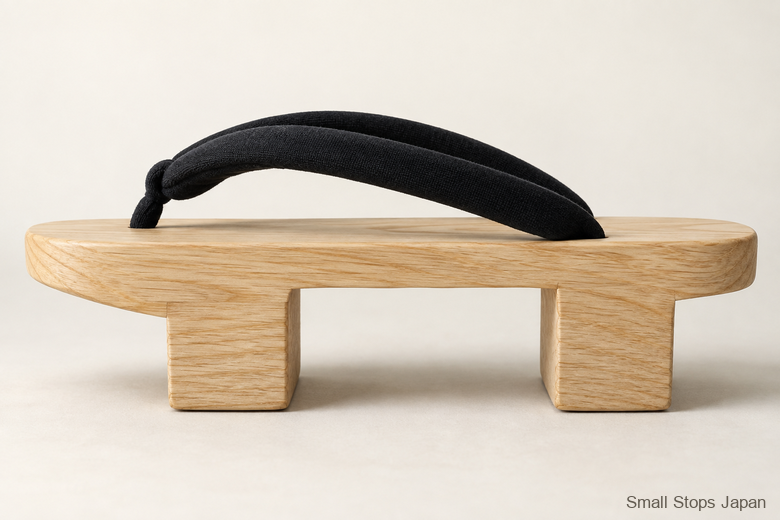
Those projecting supports are called ha, or “teeth”. They extend towards the ground below the surface that carries the foot. The manufacturer Mizutori’s glossary distinguishes this part from the dai above it. From the front, the wood can look like a simple slab; the side profile reveals a more shaped structure.
There is more than one way to make that structure. The Chiba museum describes both geta carved with the base and teeth in one piece and geta with separately attached teeth. That distinction is about construction, not strap colour. It also gives you something more useful to notice than simply calling every pair a thick wooden sandal.
Why the setta label matters
Return to the basket. Its closely patterned surfaces look very different from the exposed wood in the geta display. The sign supplies the name setta, but the top surface is only part of the story.
The Edo-Tokyo Museum’s explanation of setta describes a form of zori with leather applied to the underside. This is a definition involving the construction below the foot, rather than the presence of straps or a particular woven pattern. The soles in our basket photograph are hidden, so that description does not establish the sole material of these particular products.
The useful contrast is between the geta’s visible wooden base and teeth, and a name whose traditional definition also depends on what is underneath. Looking only at the hanao misses both.
A regional name on the display
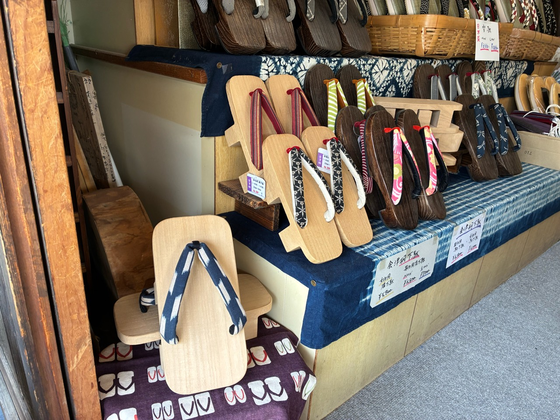
The sign Aizu kiri geta adds another layer: Aizu is the region, and kiri is paulownia wood. Fukushima’s education board introduces Aizu kiri geta as a local craft, linking the footwear with the region’s paulownia.
Here, the wording is on the display. It is not a maker’s identification for every pair in the photograph. Still, it gives the wood a local context: this is a place where a familiar everyday object can also carry a regional craft name.
Try looking back at the basket, the close view of the straps, and the illustrated side profile. The patterns may be what you notice first. Now there is a base, a set of connections and a shape underneath to notice as well.