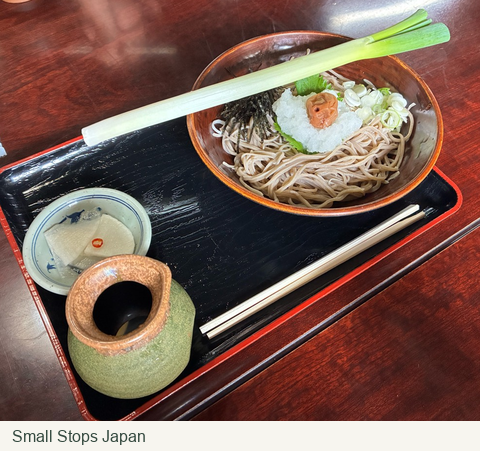
A long green onion lies across a bowl of soba. Its pale stalk reaches well beyond the bowl, making it hard to miss. But look at the tray too: a pair of chopsticks rests beside the meal.
These photographs, provided by Ryo from a visit to Komeya in Ouchi-juku, show two views of the same kind of scene: the meal as it sits on the table, and a closer moment in which the onion helps lift the noodles.
First, look across the tray
The long onion is called negi in Japanese. Here it lies almost horizontally across the bowl, above the noodles and their toppings. The chopsticks sit separately along the edge of the tray.
Seeing both matters. The onion catches the eye, but this photograph does not show a meal without chopsticks. Nor does it tell us that diners must use one utensil instead of the other. It shows what was on this particular tray.
The wide view gives you three things to follow into the next photograph: the length of the onion, the bowl beneath it, and the noodles inside.
Then, follow the onion to the noodles
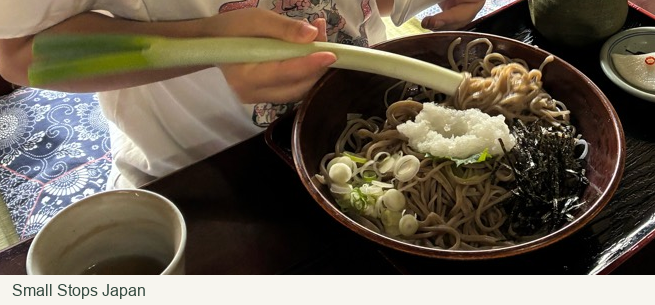
In the second photograph, a hand grips the green end of the onion. Follow the stalk toward its pale end: a small bunch of noodles is raised there, just above the bowl.
That is the useful detail in this image. The onion is doing more than lying across the food; it is being used to lift some of the noodles. Keeping the hand, onion tip and bowl rim in view makes that relationship easier to see.
The photograph captures one moment, rather than a complete guide to eating the dish.
Where this scene fits
Ryo identified the restaurant as そば処こめや — Komeya. Separately, Shimogo Town’s restaurant directory lists Komeya under Ouchi-juku and identifies negi soba among its offerings. That provides context for the long onion in the photographs.
The pictures record a visit, rather than today’s menu or availability. For this small detail of the meal, the two views work together: the first shows the onion and chopsticks on the tray; the second shows the onion meeting the noodles.