You do not need to learn one special ordering system before eating out in Japan. There is no single system: you might speak to a member of staff, use a screen at your table, or buy a meal ticket before your food is prepared.
If you already use self-order kiosks at home, part of this will feel familiar. Such screens also exist in the United States, including at McDonald’s, as described in McDonald’s account of its US restaurant changes. The useful question in a Japanese restaurant is what this shop expects you to do next.
Start with the way this restaurant takes orders
A menu on a table, a queue at a counter and a ticket machine are clues. Pause at the entrance, look for instructions, and follow the staff’s directions about the queue and seating. The name of the food alone will not tell you how to order.
These are some ordering methods you may encounter. They can overlap; they are not a complete classification of Japanese restaurants.
- Speak to staff at your table. Choose from the menu and tell a member of staff. A call button may be provided. GO TOKYO’s dining guide describes table ordering and explains that payment may be at the table or a register.
- Order at a counter. Tell the staff what you would like at the ordering counter, then follow the payment and collection instructions. Counter orders and self-order kiosks both appear in McDonald’s Japan’s explanation of its ordering channels.
- Use a tablet or your phone. Select dishes through the restaurant’s system. Ordering on a screen does not, by itself, tell you when to pay. For example, Matsuya’s mobile ordering guide explains app ordering without a ticket machine, with different collection arrangements for its self-service and other shops.
- Buy a meal ticket. Choose and pay at a machine, then follow the shop’s instructions for the ticket and your food. This is the method we will look at more closely below.
Digital ordering has operated at scale within at least one large restaurant group. Skylark Group’s Integrated Report 2024, page 23 (PDF), reported digital menu books at 2,500 of its stores. That is one restaurant group’s reported scale, not a count of all Japanese restaurants or a current nationwide percentage.
What is a meal ticket?
A meal ticket is called a shokken (食券). In the systems discussed here, you buy a paper ticket for your food from a ticket vending machine, or kenbaiki (券売機). The machine issues the ticket; the kitchen prepares the meal.
Keep any ticket or receipt it gives you. A slip can be something staff need to receive, or it can carry the number you will use to collect your meal. Those are different jobs for a similar-looking piece of paper.
Before you leave the machine
Check the dish, quantity and displayed price before confirming. If the machine asks whether you will eat in or take away, choose the option you need. Follow its instructions about selecting food and paying: the sequence and accepted payment methods can differ.
Collect your ticket, any receipt and any change before moving away. If you are unsure whether payment went through, ask staff before buying the same meal again. A second purchase is not a reliable way to fix an uncertain first payment.
Hand over the ticket, or wait for a number?
The next step depends on the shop. These two official examples show why it is worth checking:
- Hand it to staff when instructed. In ICHIRAN’s system guide, diners complete a preference sheet at their booth, call staff using the button, and hand over the sheet with all their meal tickets. The ticket alone does not express those extra preferences.
- Keep it while you wait. In Matsuya’s self-service guide (PDF), buying a ticket sends the order automatically. Diners keep the ticket and wait at their seat, then take it to the counter when their number appears as ready. A number in the waiting section is not the same as a ready notification.
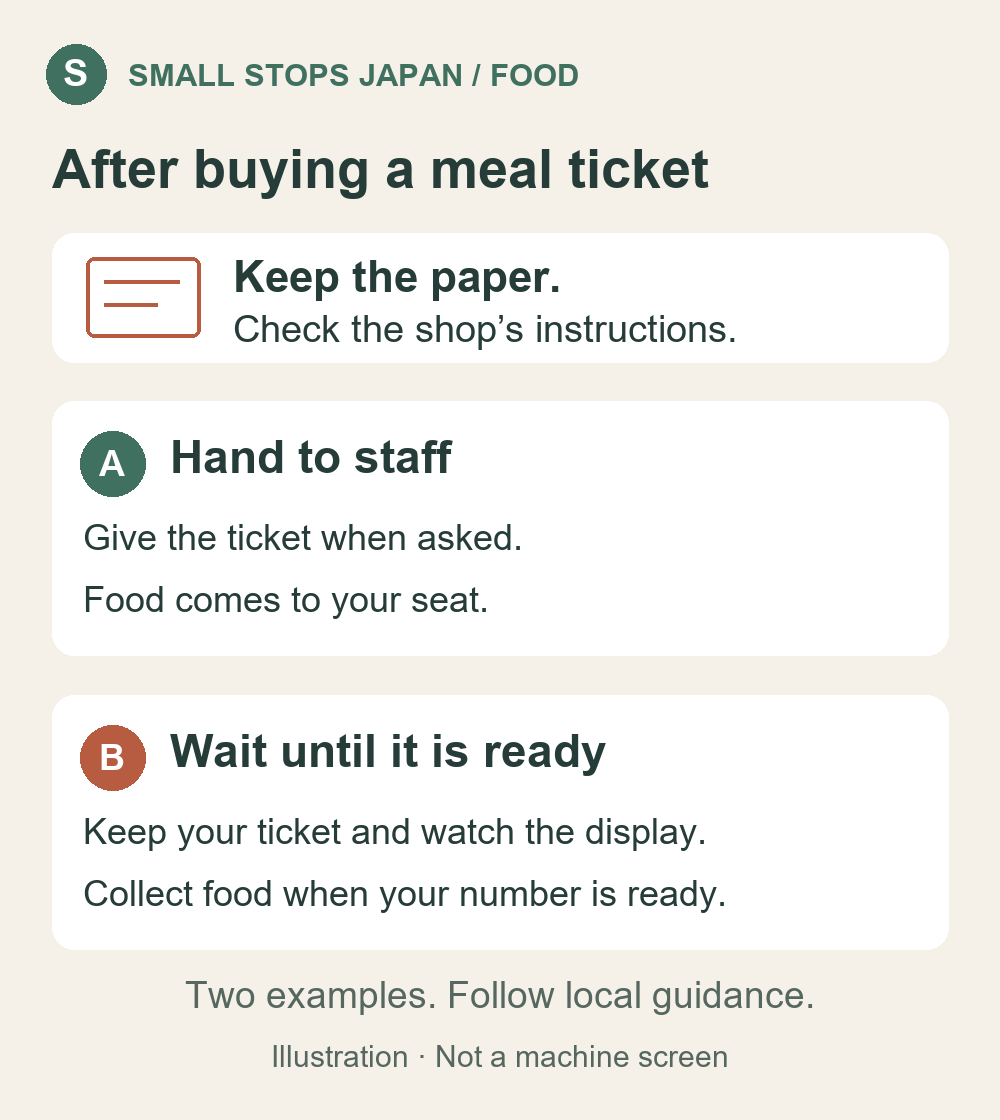
You do not need to memorise a screen layout from a guide. At the restaurant, look for the distinction between orders still being prepared and those ready to collect. If the display is unclear, show your ticket to a member of staff.
A small question can clear things up
While showing the ticket, you can say: “Sumimasen. Kore wa dō sureba ii desu ka?” (すみません。これはどうすればいいですか?) — “Excuse me. What should I do with this?”
For a mistaken order or a payment problem, keep the slip and explain what happened before making another purchase. Staff can tell you what is possible; changes and refunds should not be assumed.
Once you separate ordering, paying and receiving the food, the different systems become easier to follow. A familiar-looking machine can still lead to a different next step.
Restaurant guidance checked on 12 September 2026. The store figure is from the named historical report. Procedures can change by location.
Image credits: Small Stops Japan. Image-use notes.