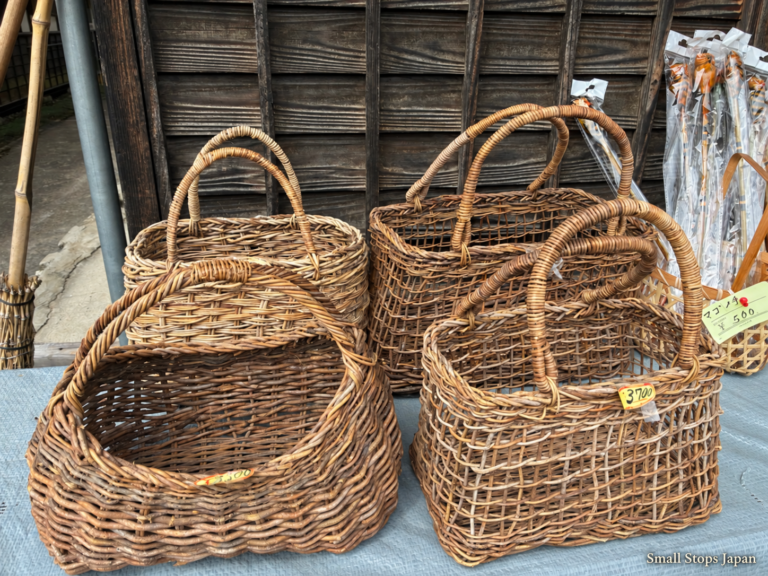
At a shopfront in Ouchi-juku, Ryo photographed a cluster of brown woven baskets. Some were low and rounded; others had taller, straighter sides. Looking at them together raises a useful question: would you leave a basket in one place and reach into it, or pick it up with everything inside?
That question gives you more to work with than colour alone. Look at the opening, the depth and the handles, then imagine one ordinary job you would want the basket to do.
Start with the opening
In the photograph, the low basket at the front left spreads out around a broad opening. The rectangular basket at the front right has higher sides and a more open weave. Both have handles, but the space between those handles matters too: a wide rim does not necessarily mean an unobstructed route for your hand.
Imagine storing two folded cloths. Placed side by side in a shallow basket, either can be seen and reached without lifting the other. Stack the same cloths in a narrower, deeper basket and the bottom one becomes a second step: move the top cloth first. Neither arrangement is wrong. One favours quick access; the other may suit the particular space you have available.
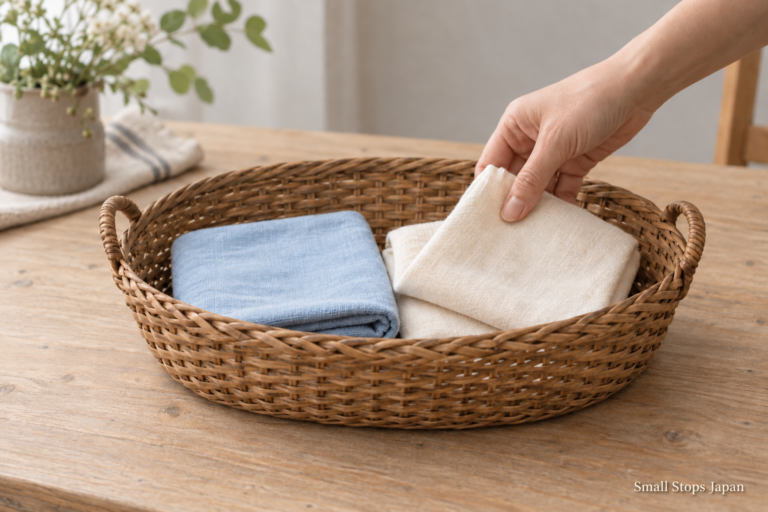
For cloths you reach for every day, picture the basket in its actual place. Would you lift something straight out from above, or pull the whole basket off a shelf first? A handle arching over the centre can be convenient for lifting the basket while getting in the way of a larger object coming out. Check the opening with the object you intend to store, rather than judging from the outside shape alone.
Give small belongings an inner bag
The gaps in an open weave are easy to overlook when the basket is empty. For a few small belongings, a cloth pouch or inner bag makes a separate container inside it. In the example below, a notebook and a pouch sit together inside a fabric bag instead of directly against the open sides.
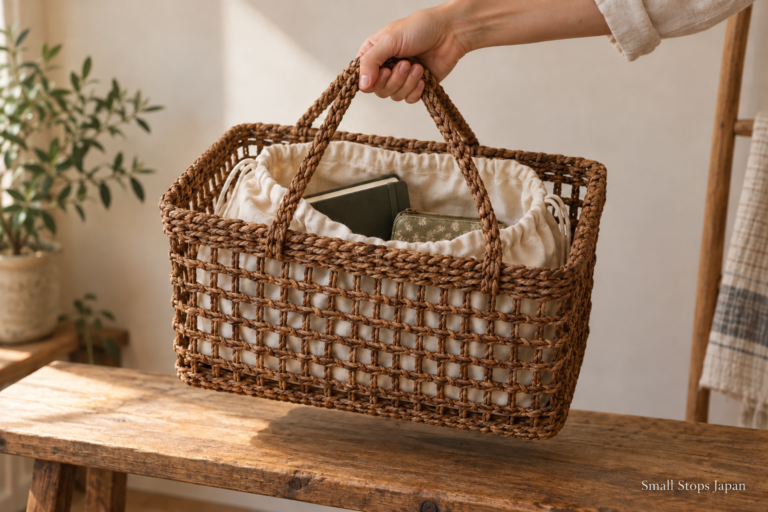
That changes the routine as well as the appearance. You can take the bag out and leave the basket behind, or keep the bag inside while moving the basket. The extra layer also means you reach through a second opening. If the bag is much taller than the basket or its mouth closes around the contents, finding something quickly may take another movement.
For a basket you intend to carry, try the handles together while it is empty. Notice whether there is comfortable room for your fingers and whether the opening remains usable when you set it down. Ask the seller about the intended use and suitable load; the thickness or appearance of a handle alone cannot answer that.
Choose a job before choosing a basket
A useful shopfront comparison is simple: imagine the same belongings in each shape. For folded cloths, can you see and lift the one you want? For small items, would an inner pouch help? For moving things between rooms, can you comfortably gather the handles? If the basket belongs on a shelf, allow room above it for your hand as well as the handle.
The photograph does not identify the baskets’ plant material, maker or place of manufacture. Those are questions for the seller, along with care instructions. There is no need to guess a material from its brown colour or assume that every woven basket can be washed in the same way.
A basket is familiar far beyond Japan. What makes this small stop interesting is seeing several shapes together, then following each shape through an everyday action: reaching in, taking something out, or gathering everything up to carry.