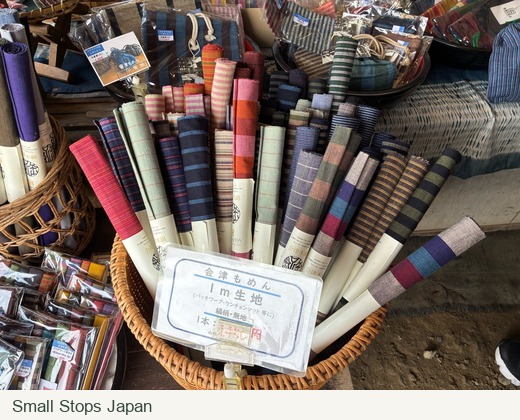
A basket of colourful fabric rolls is one way to meet Aizu momen, a traditional cotton textile from the Aizu region of Fukushima. But you do not need to sew to bring it into your life. Local makers and shops also offer finished bags, pouches, clothing and household accessories.
Ryo’s photograph from Ouchi-juku shows the material before that transformation: rolls labelled as one-metre pieces of fabric. The colours and patterns are the starting point. What you might carry, wear or keep on a table comes next.
A textile with a home in Aizu
The word momen means cotton. Aizu momen is one of the area’s traditional crafts and regional specialities. Local weaver Yamada Momen explains how different coloured threads form its striped cotton fabrics. The maker also describes the textile’s long connection with the region’s everyday life.
In the shop photograph, narrow lines, broad bands and pale checks offer different ways to use colour. The photograph shows a selection at one shop; it does not identify the maker of every roll. Nor does every Aizu momen item have the same pattern.
Something to carry: bags and pouches
Finished accessories offer a way to choose the cloth through an object you already use. A tote gives a pattern a large surface; a pouch brings it into a smaller object that can sit inside another bag.
These are real product categories, not just craft-project ideas. The Minamiaizu Tourism Association’s introduction to MON & MARI, dated February 2026, lists bags, pouches and other accessories made mainly with Aizu momen. It also links to the workshop’s online sales channels.
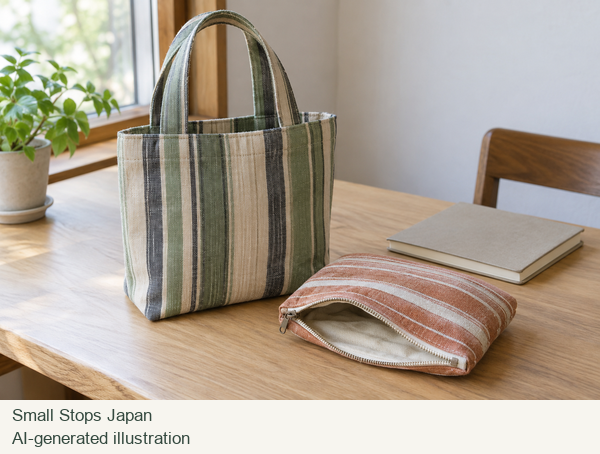
When looking at an actual bag, consider its opening, handles and internal space as well as the pattern. Those details belong to the finished design, so check the specific maker’s description rather than assuming every bag is constructed alike.
Something to wear
Aizu momen also appears in clothing. Aizu-Wakamatsu’s official tourism guide introduces shops selling garments and accessories alongside fabric. Its examples include Yamada Momen and Momen Ito.
Clothing lets the pattern occupy a larger part of an outfit. If that feels like too much colour or too many stripes, a small accessory is another entry point. You can choose the scale of the pattern you want to bring into your day.
Something for the room
The MON & MARI introduction also lists tissue-box covers, pocket-tissue cases and coasters. These bring the fabric into ordinary household routines: reaching for a tissue or setting down a cup.
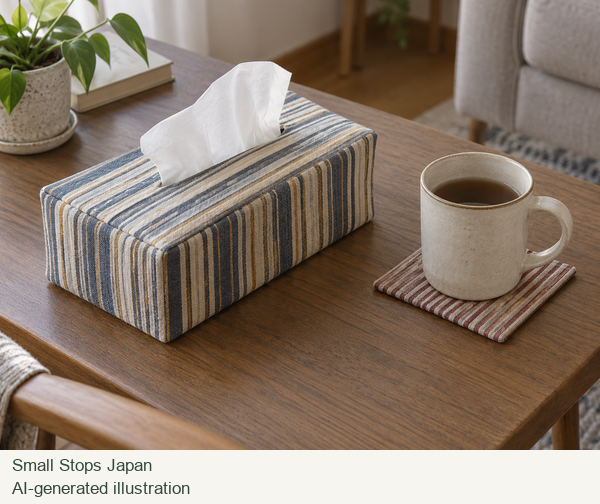
A small coaster offers one patch of colour; a tissue-box cover makes the fabric more prominent. The useful question is which object you would enjoy having around you.
Choose an object, then explore the cloth
At a fabric display, you might begin by imagining what to make. With finished Aizu momen goods, you can start from what you would use: a pouch for small belongings, a bag, a garment or something for your room.
The official introductions above are places to explore real makers and products. Check the seller’s current selection, materials and care instructions for the item you choose. The possibilities extend well beyond a roll of cloth in a souvenir shop.
Official sources checked on 5 October 2026. Product categories are documented by the linked sources; the two generated illustrations are explanatory examples, not a catalogue.