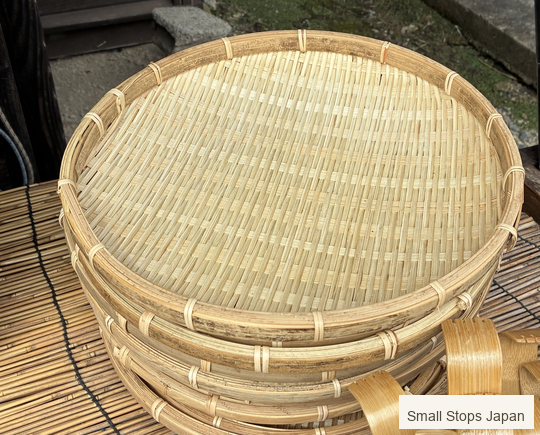
At a shop in Ouchi-juku, Fukushima, I photographed a stack of shallow woven trays. The baskets have broad faces, low rims and narrow woven strips. A tray like this can look more like a serving plate than a kitchen strainer.
The Japanese word zaru (ざる) helps connect those two ideas. It is used for baskets and strainers involved in preparing and serving food. Here, we will follow a shallow bamboo version through three different moments: draining noodles, bringing them to the table, and drying the empty basket afterwards. The shop photograph is our starting point; the illustrated kitchen scenes show general examples, not a test of those particular products.
A broad surface, with a way out for water
Look at the photograph before imagining any food on it. The woven face spreads across most of the circle. Around it, a thicker rim holds the outline, with bindings at intervals. The sides rise only a little, leaving the surface easy to see.
A food-use bamboo zaru brings a useful difference from a solid plate: water can pass through the weave. The food stays above while excess water has somewhere to go. The rim and the depth still matter, because a shallow tray does not contain its contents in the same way as a deep bowl.
Taketora’s guide to bamboo zaru includes flat baskets for presenting noodles and deeper forms for jobs such as draining vegetables. Zaru is a family of tools, rather than one standard shape for every kitchen task.
First, drain; then change its job
For a noodle example, Naito Kanamono’s bamboo-zaru introduction describes both draining and serving soba or somen. Soba are buckwheat noodles; somen are thin wheat noodles. This is a use described by the retailer, not a claim that the baskets in my photograph have been tested for it.
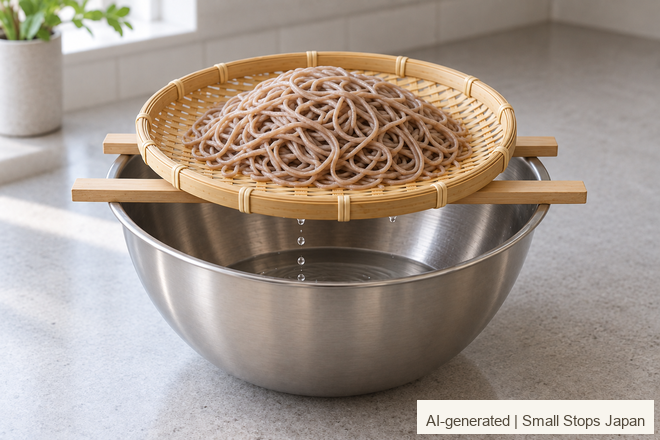
In the draining illustration, rinsed noodles sit in a shallow basket resting on two wooden supports across a bowl. The bowl catches the drips, and the basket stays above the collected water. Notice the space beneath the weave: placing the basket in that water would defeat the point of letting it drain.
The next scene moves to the table. The drained noodles are arranged on a shallow zaru, with dipping sauce in a separate cup. The basket now has a serving role. It holds the noodles in view while the liquid belongs in another vessel.
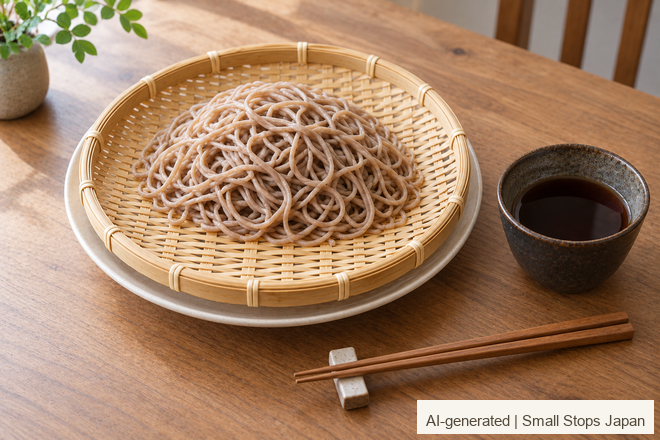
The pictures show two uses of a similar shape, not a complete noodle recipe. That shift is the interesting part: something that helps prepare the food can also become the surface on which you serve it.
A fine weave has a different job
Would the same basket work for loose rice? The name alone cannot answer that. Grain size and the openings in the weave matter as well as the basket’s depth.
In its rice-washing basket FAQ, Taketora distinguishes its closely woven rice-washing basket from a coarser draining basket. Even its rice-washing versions can catch a few grains. A shallow noodle tray should not become a rice-washing tool simply because both are called zaru.
Finish by drying the basket itself
After the food is gone, the basket needs attention too. Taketora’s care advice recommends a quick rinse, wiping off moisture and thorough drying in a ventilated place away from direct sunlight. It also advises against soaking and dishwasher use. Follow the instructions for your own basket, especially where materials or finishes differ.
The final illustration shows the empty basket standing in a rack, with space around both faces. Leave it out until fully dry before stacking it away. There is no fixed drying time to memorise; the important change is from a wet utensil to one ready for storage.
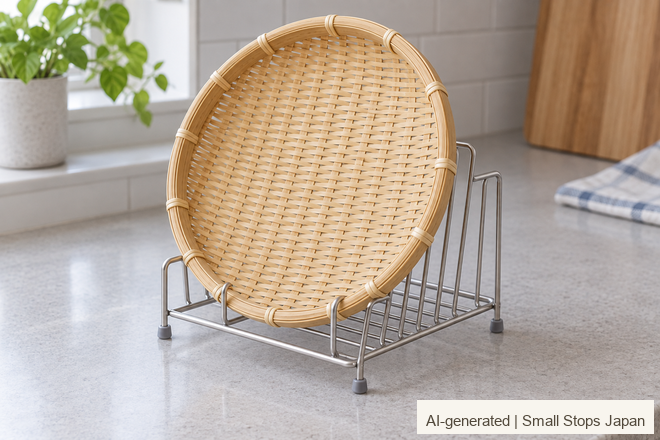
These food-use bamboo zaru examples show how a shallow basket can move from preparation to presentation. Its role changes with the task: draining noodles, serving them, then standing empty with room to dry.