These photographs from my September visit to Bunke Tamaya, a café in Ouchi-juku, show wooden furniture sharing the room with plants, a telephone and trays of dishes. One piece has drawers beneath a row of steps; the large box provides a place to return tableware. Their shapes and the objects around them tell different parts of the story.
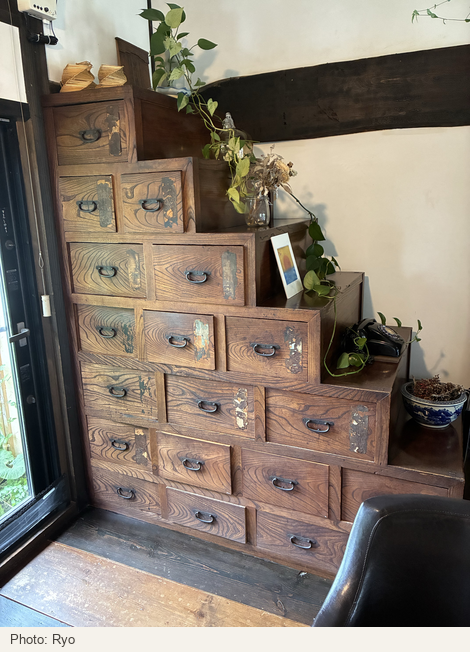
Why put drawers in a staircase shape?
The first piece is highest on the left and descends to the right. Drawer fronts fill the space below.
There is a Japanese furniture type called kaidan-dansu, or staircase chest, that brings stairs and storage together. The International Christian University museum's example on Cultural Heritage Online illustrates that combination. Knowing the idea makes the stepped outline easier to understand: the space beneath the steps can be part of the storage, rather than simply an empty area below a stairway.
At the café, a trailing plant follows the descending outline, and a black telephone rests on a lower surface. No route to an upper floor is visible in this photograph. The steps instead provide a series of places for objects at different heights.
A front divided into different spaces
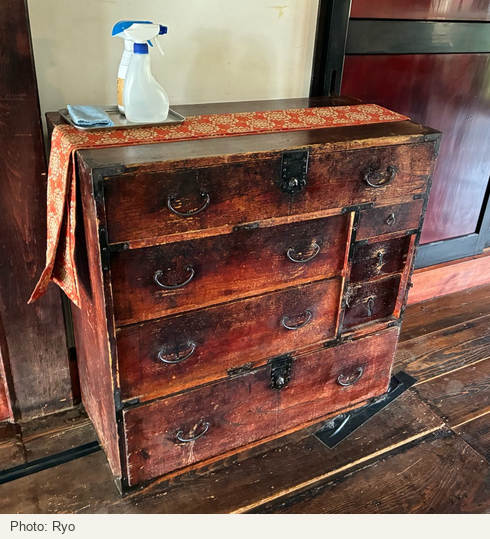
The next piece has a rectangular outline, but its front is not a uniform grid. Broad drawer fronts sit beside smaller ones on the right, with a door-like section below those small drawers. Looking at the boundaries between the panels tells you more than counting the handles alone.
Tansu is the Japanese word often translated as a chest of drawers. The Tokugawa Art Museum's glossary of hina-doll furnishings explains that drawer sizes were made to suit the things they held. The different sizes reflect a simple storage principle: separate spaces can suit different contents. The café photograph lets us see the arrangement, even though the contents remain out of view.
A wooden box for returning dishes
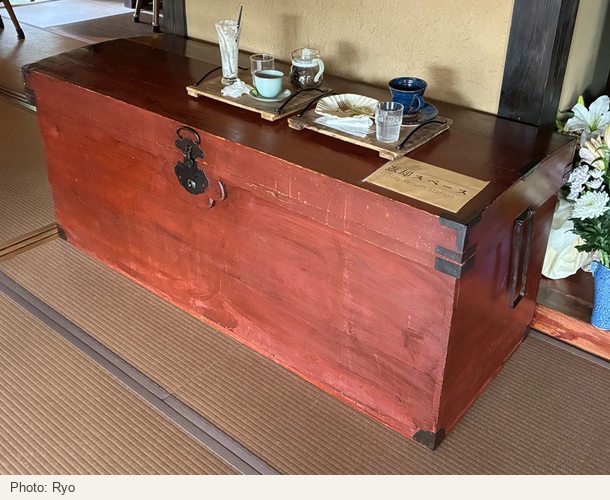
The large box has a long, largely uninterrupted front, without rows of drawers. A metal fitting sits near the centre, while a large handle is visible on the side. A handle on storage furniture need not be a drawer pull.
The Tokugawa Art Museum's glossary describes one kind of large storage chest, nagamochi, with end fittings for a carrying pole. Those fittings served transport rather than opening drawers. This is background to the furniture type, not an identification of the café's box, whose history is not recorded here.
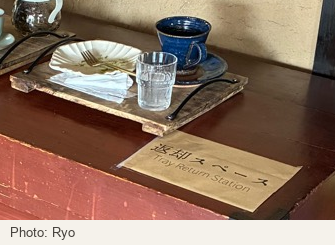
Now look above the metalwork. The broad top holds trays, cups and plates, and the sign reads 返却スペース — “Return area.” Together, the dishes and the sign explain the box's role during my visit.
The photographs show the drawers closed, yet the objects on top reveal the furniture's place in the café's everyday activity.