A folded cloth on a kitchen counter tells you very little about its job. Put it in someone’s hand, beside a plate or against a worktop, and the purpose becomes much clearer. That is a useful way to get to know a fukin (ふきん), a kitchen cloth you may encounter in Japan.
The task itself may be familiar from your own kitchen. Here, the name is the starting point for two everyday scenes: drying a dish and wiping a surface. The AI illustrations show fictional examples, not a particular product or a home we visited.
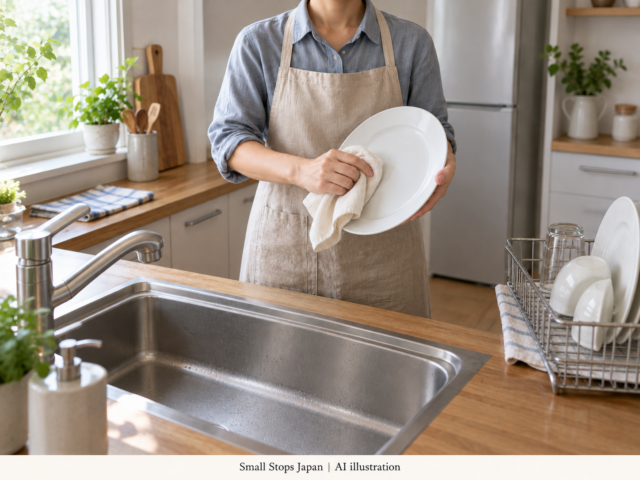
From the shelf to the kitchen
Fukin are not all made alike. For one documented example of their uses, Nakagawa Masashichi Shoten describes its Hana Fukin as suitable for wiping dishes and tabletops, among other tasks. That is a description of that product; the cloths illustrated here do not represent it.
The wider kitchen view gives the first cloth a setting. The sink, plate rack and dish in the person’s hands connect the small piece of fabric to work being done with tableware.
A hand for the plate, a hand for the cloth
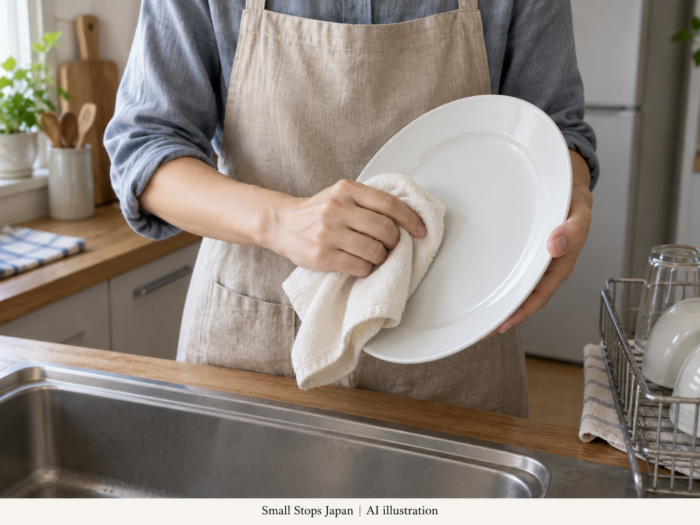
In the closer view, the two hands have different jobs. On the right of the picture, a hand supports the tilted plate. The other hand gathers the cloth and holds part of it against the inner surface. The uncovered rim helps you see where the plate ends and the fabric begins.
The cloth bends to meet the dish, while the plate remains supported. This is one way to picture the action, rather than a rule about the angle of the plate or which hand to use.
A flat cloth against the worktop
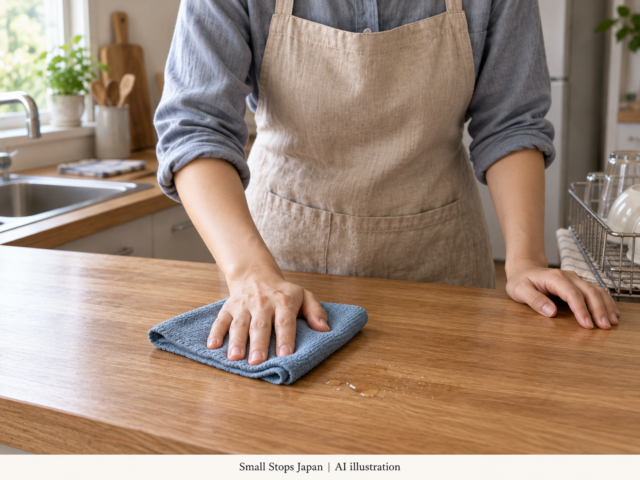
Here the worktop stays in place. The cloth is folded flat beneath the palm, with its edges visible around the fingers. A few drops nearby give context to the wiping action. Compare that broad contact with the gathered fabric against the curved plate.
The change is in the surface being wiped and the way the cloth meets it. The picture is an explanation of the task, not a test of absorbency or cleaning performance.
Colour alone does not tell you the job
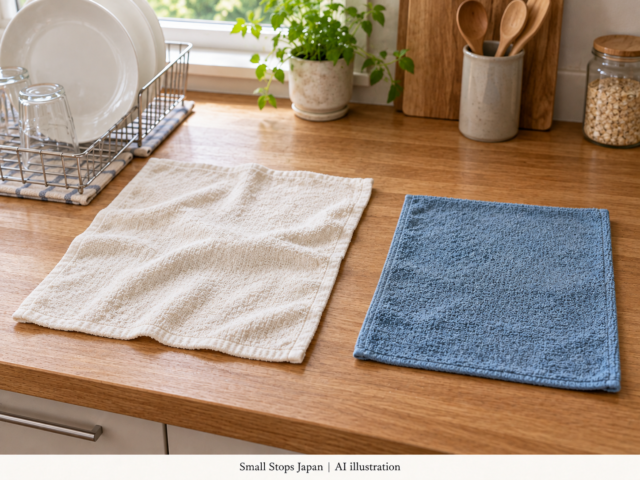
With both cloths laid out, the objects look much less specific than they did in use. We chose two colours to make the examples easy to follow; they are not a Japanese colour code for kitchen cloths.
If you are helping in someone else’s kitchen, ask which cloth they use for the dishes and which for the table. The word fukin gives you a name. The task, surroundings and household’s own way of using it supply the rest.