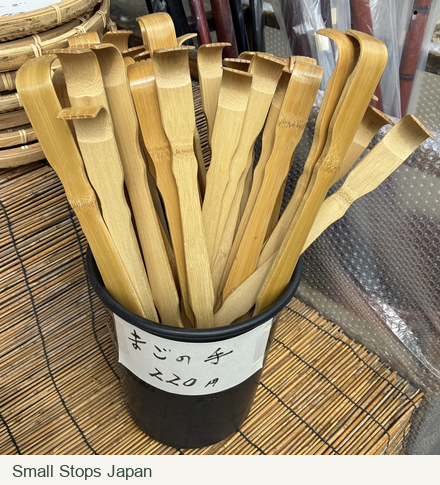
A cluster of curved bamboo ends rises from a black container in a photograph from Ouchi-juku provided by Ryo. The handwritten label reads まごの手 — magonote. These are back scratchers: long-handled tools for reaching an itch on your back.
The name may be unfamiliar even if the purpose is familiar. In this shop display, the most useful clues are above the label: broad ends that curl over, with small notches along their edges.
From a bundle to a single tool
The container holds the scratchers upright, hiding their lower ends. That makes the display a good view of the curved tips, but a less clear view of one complete object.
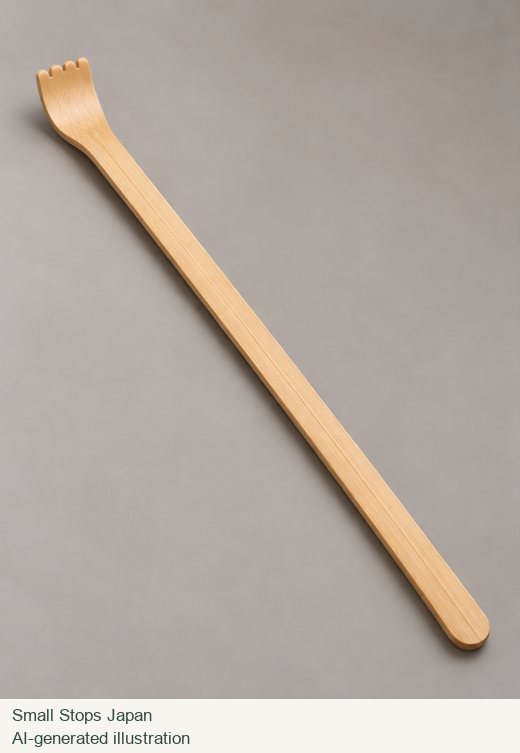
The illustration below shows the whole shape: a long bamboo handle with a plain grip at one end and a curved, notched tip at the other. Follow the handle from one end to the other and the bundle becomes easier to read.
Look closely at the curved end
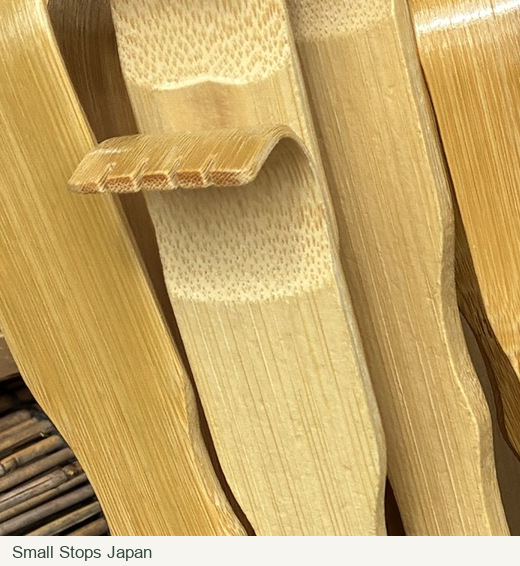
In the enlarged shop photograph, the bamboo broadens into a curved tip. Several shallow cuts divide its outer edge into short sections. A broad bamboo surface remains behind these short cuts.
This detail is easy to lose in the bundle. Seen closer, the change from a long, narrow handle to a wider, bent end gives the tool its hand-like outline.
What the long handle does
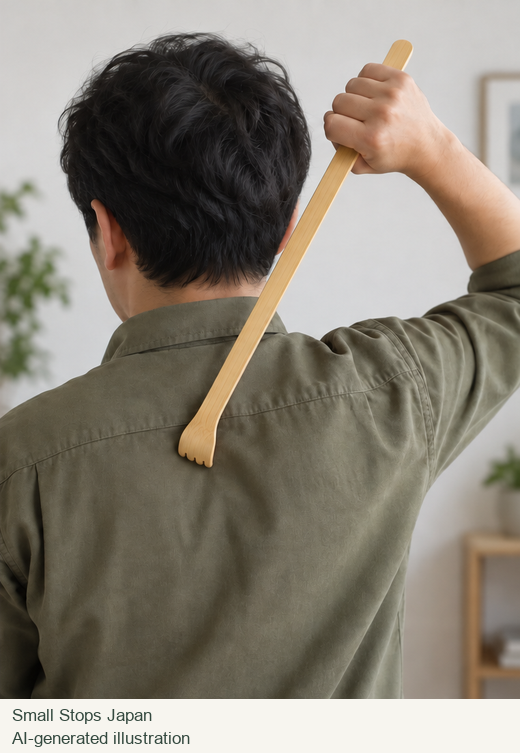
One end stays in your hand while the curved end reaches your back. The handle supplies the reach that a small scratching edge alone would not have. The Japan Foundation’s Japanese-learning material also identifies magonote as a tool for scratching your back.
Back in the first photograph, the repeated curves now have a purpose. The label supplies the Japanese name; the close view shows the small working end; the full shape explains how it reaches. A bundle of bamboo sticks becomes a recognisable everyday tool.