A short curtain hangs across a doorway, with the floor and part of the room still visible beneath it. Is it decoration, or something you can walk through? A noren (暖簾) can mark an entrance or divide a space. In the split design shown here, the lower panels move apart while the fabric remains joined above.
These illustrations follow one fictional entrance: first the whole curtain, then its hanging structure, then a person passing through. They show how this example works, rather than a single design or custom shared by every place in Japan.

Start with the whole doorway
The noren in the wide view covers only the upper part of the opening. Its lower edge hangs well above the floor, and a vertical slit separates the two lower panels. Above the slit, the panels are still connected. That small joined area matters: this is not a pair of independent curtains that can slide freely to opposite sides.
Textile maker Sapti’s explanation of noren describes their use at shop entrances and between rooms, with multiple pieces of fabric connected at the top. Our plain teal example makes that structure easy to see without a shop name or a printed design competing for attention.
Look up: the rod, the loops and the joined fabric
In the closer view, a wooden rod rests in a metal support at each side of the doorway. Six matching fabric loops pass over the rod and attach to the curtain. Follow the centre line down from the top: it stays closed for a short distance, then opens into the slit.
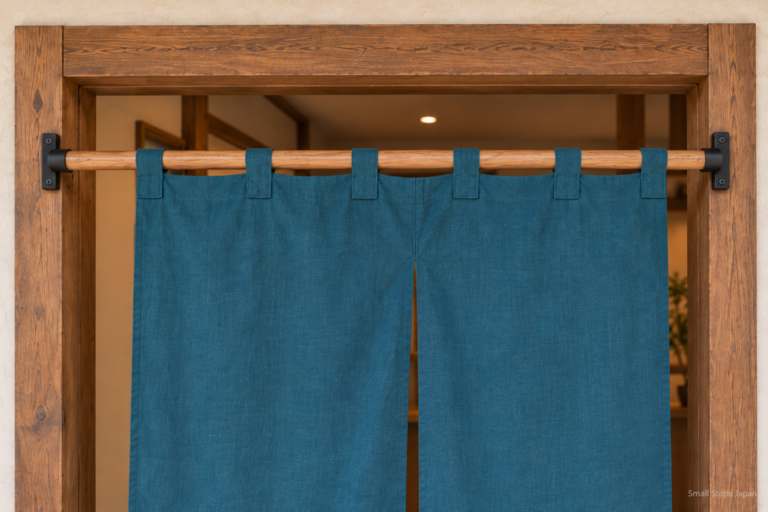
The loops are one way to hang a noren. Japanese maker Order Noren also describes a sleeve-style top through which the rod passes. A curtain without visible loops may therefore use a different top finish. The six loops in our illustration belong to this example; they are not a required count.
The slit gives the body a way through
Now compare the empty doorway with the person below. One hand holds an inner fabric edge aside. The head is below the point where the slit ends, the torso is between the panels, and one foot has already reached the outside. The lower panels can move around the body because they are separate; the joined upper section stays above it.

How much someone needs to bend depends on the clearance, not a set bowing gesture. Order Noren’s comparison of different slit lengths illustrates how changing the slit affects passage through a curtain. The pictures here are explanatory illustrations, not a reconstruction of that test or a measurement guide.
At an entrance you are meant to use, notice where the opening stops and allow room for your head, shoulders and anything you are carrying. There is no special left-hand or right-hand sequence being demonstrated here. If the entrance or a room beyond it seems private, check a sign or ask staff rather than treating the cloth itself as permission to enter.
A curtain does not answer every question about the shop
Recognising a noren tells you what the hanging object is. It does not, by itself, establish today’s opening hours or whether every space behind it is open to visitors. For those questions, use the shop’s notice or ask.
The detail to look for next time is the end of the slit. From a distance you see a curtain; up close you can see how its joined top and moving lower panels work together.
All three images are original AI-generated illustrations by Small Stops Japan. They depict a fictional example, not a real shop, product or visit.