On this shop shelf in Ouchi-juku, the little figures have black-topped heads, faces drawn with a few fine lines, and rounded bodies in red, blue and yellow. Some stand together on a tray; another peeks out of a small wooden drawer. At first, they might look like decorations chosen simply for their cheerful faces.
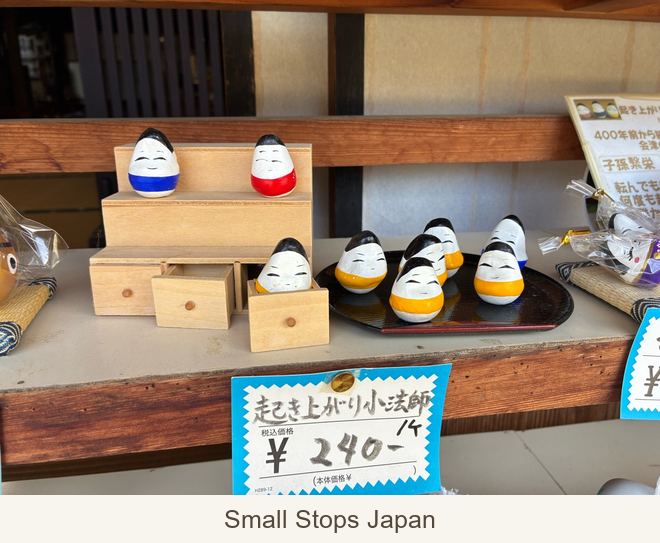
They are okiagari koboshi (起き上がり小法師), a folk craft associated with Aizu in Fukushima Prefecture. Their distinctive feature becomes clear when they are tipped over: they return to an upright position. That small movement helps explain why they are also valued as good-luck charms. Aizu’s regional tourism guide connects their return to standing with perseverance.
Look closely at the little figures
The shelf photograph shows several versions together. The red and blue pair on the wooden steps have similar outlines, while the group on the tray includes yellow-bodied figures with slightly different faces. Even within this one display, the colours and expressions vary.
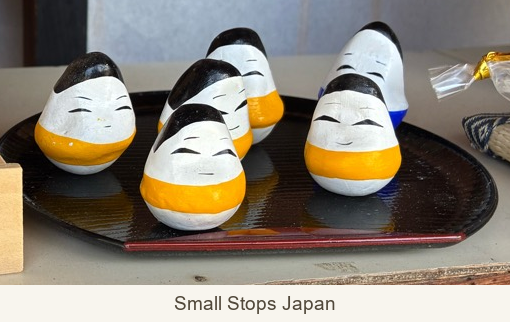
The Fukushima Prefectural Board of Education’s introduction describes a small, roughly 3 cm (1.2 in) example with a red body and black head. That gives an idea of the compact form, rather than a measurement of the dolls in this photograph. Their exact sizes were not recorded.
The movement gives the charm its meaning
Imagine the same doll in three positions: upright, tipped to one side, then upright again. The change to notice is the whole figure returning to standing. A still photograph can show the rounded outline, but it cannot show that return by itself.
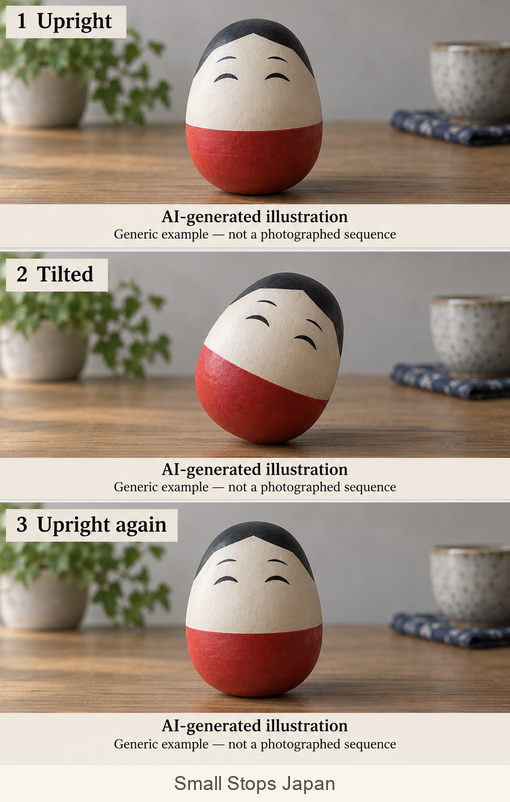
Aizu-Wakamatsu’s official introduction to Yamada Folk Craft Workshop connects this movement with nanakorobi yaoki, often expressed in English as “fall seven times, get up eight”. The saying is about persisting through setbacks. Here, it becomes something visible in a small object: getting back up is part of what the doll does, as well as the wish attached to it.
The regional accounts also associate the charm with wishes for health and the household’s wellbeing.
Why one more than the family count?
There is another detail that makes the doll more than a single souvenir. The local accounts describe a custom of buying one more than the number of people in the family at the New Year market. A family of three, for example, would buy four. The workshop’s official tourism listing links the extra one with a wish for the family to grow and prosper.
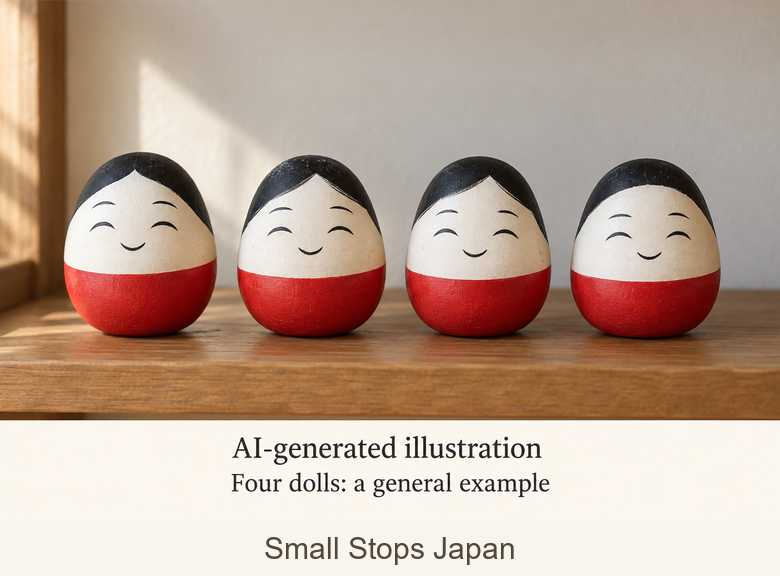
The custom belongs to Aizu’s New Year traditions. The group on the shop shelf is a sales display, rather than an example of a family’s chosen number.
The educational guide places the dolls among the good-luck items associated with Tokaichi, Aizu-Wakamatsu’s January 10 market. That New Year connection adds context to an object that can also catch your eye on an ordinary shop shelf. This photograph was taken in Ouchi-juku, not at Tokaichi.
The rounded figure, the return to standing, and the extra one chosen for a family each reveal a little more of the same object. Once you know those connections, a row of small smiling faces has another story to tell.