Ouchi-juku is a former post town in Shimogo, Fukushima Prefecture, Japan. It served travellers and transport along the old Shimotsuke road, while its residents also farmed the surrounding land.
From the street, its thatched roofs form broad slopes above the shopfronts. Move closer to an eave—the lower edge projecting beyond the wall—and that large surface resolves into many small stems. How does a street of old houses keep its familiar appearance when the material covering them needs repair?
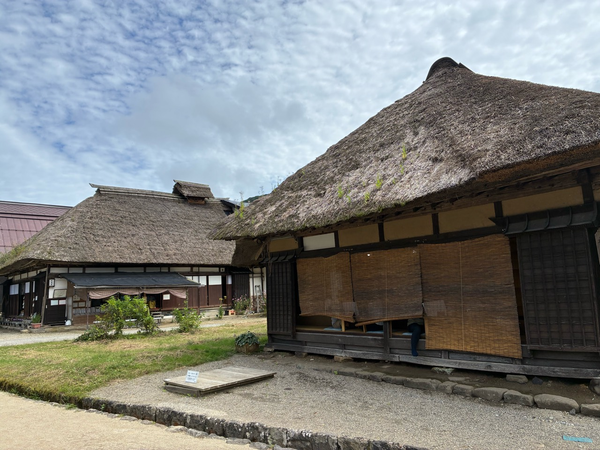
Start with the roof and the house together
In the view of two neighbouring buildings, follow the roof down towards the windows and wooden walls. The thick edge extends out above the facade. The building on the right continues beyond the photograph, while its neighbour gives us another roof outline to compare.
At the edge, the material becomes visible
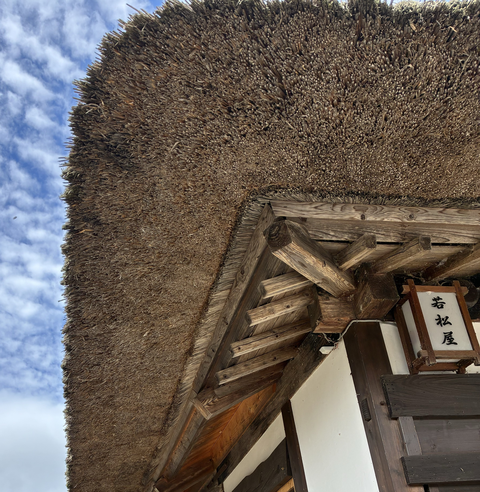
The upward view of the eave brings the ends of the stems into focus. Below them are much larger wooden members. Their different scales are easy to follow: many fine pieces gathered into the roof covering, with substantial timber visible underneath.
The Japanese word kaya (茅) is a collective term for plant materials used in thatching, rather than the name of one botanical species. Japan’s Agency for Cultural Affairs includes plants such as susuki grass and reeds, as well as rice and wheat straw, in its explanation. That range helps explain the word; it does not identify the species in this particular roof.
Under the same eave, a shopfront
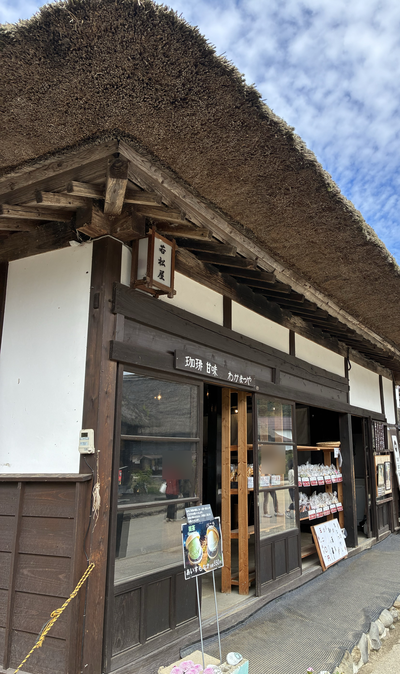
The next photograph shows the same building from a different angle. Let your eye travel from the roof edge down past the exposed wood to the wall, doorway and goods at the entrance.
Keeping the roofs means working on them
The Ouchi-juku Preservation Foundation describes two scales of care: major rethatching and repairs called sashigaya between those larger projects. Smaller repairs help prolong the roof’s life before another major renewal is needed. Preserving a thatched roof therefore includes work on its covering over time.
That work also needs people. The foundation describes residents contributing labour through yui, a form of mutual cooperation, alongside support for training thatchers. Its account points to both the cost of materials and the difficulty of securing specialist workers.
Shimogo Town adds another part of the picture: local people practise thatching and pass on skills to younger people, while maintaining nearby grass-growing areas to secure roofing material. The roof connects to land beyond the street, where the next supply of material can grow.
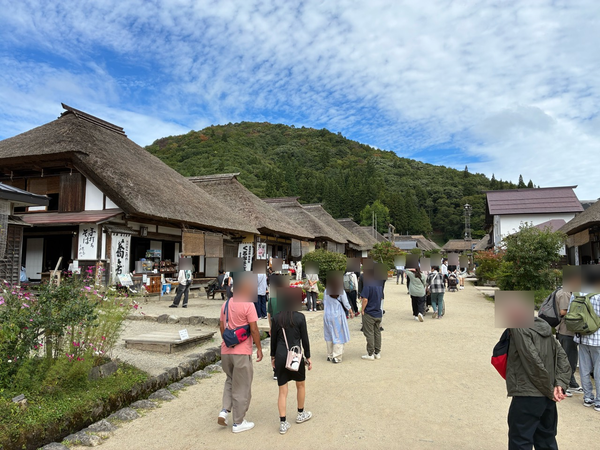
In the wider street photograph, the separate roofs become a row again. This view shows the setting being cared for, rather than the repair work itself. After the close views, each roof carries a more concrete story: plant material at the edge, a building beneath it, and an ongoing need for materials and skilled hands. The familiar outline of the street can endure while the work of maintaining it continues.