Your Shinkansen reservation says car 6, seat 12A. At the station, a sign says 15. These numbers can all be correct: one identifies the track, one the carriage, and one your place inside it.
This guide follows a fictional reserved-seat example on the Tokaido Shinkansen. The pictures are AI illustrations, not photographs of a particular station or departure.
First, match the train—not just a number
Before following a platform sign, compare your reservation with the departure board. Check the travel date and departure station, then match the train name, service number and departure time at that station. A number after a name such as Nozomi identifies a service; it is different from the car number within that train.
Also read the destination: the board may name the train’s final stop, beyond the station where you will get off. The two station names do not have to be identical. Confirm that the service stops at your booked arrival station.
Read across the matching line to find its track or platform number. JR Central’s Shinkansen guide shows how the departure display groups train information. Use the current station display for your journey; the numbers below are only an example.
Keep your reservation details available. If you use Smart EX, its reservation guidance explains that you can check the train and seat details in your reservation list. You do not need to learn this distinction from a particular paper-slip design.
15番線: which track to board from
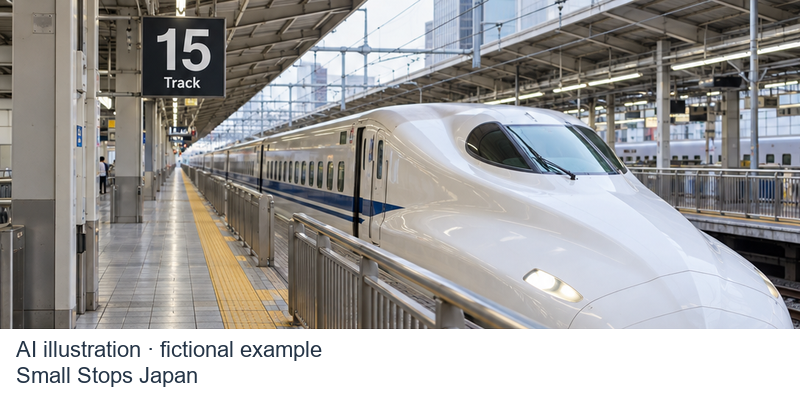
番線 (bansen) identifies a numbered track at the station. English signs may use “Track” or “Platform”. It tells you which side to board from, rather than which part of the train contains your seat.
A platform can have tracks on both sides, with a different number for each side. JR Central’s Tokyo Station map shows the Tokaido Shinkansen tracks numbered 14–19. That map helps you understand the layout; it does not assign today’s train to a track.
In our example, the departure board directs you to 15. The sign belongs to the station. It does not mean car 15, and it does not identify a seat.
6号車: which carriage to enter
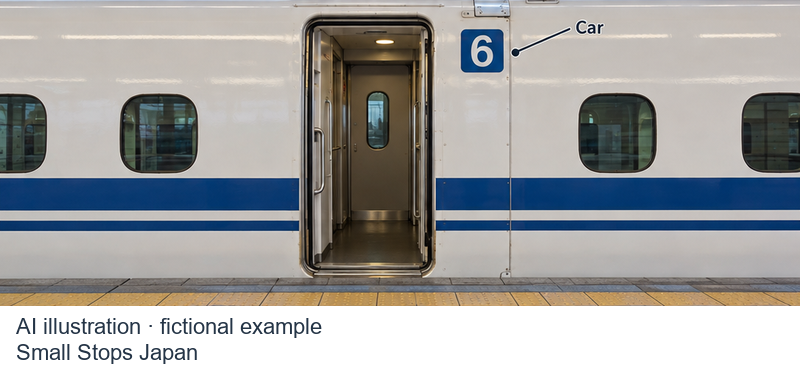
号車 (gōsha) means the numbered car, or carriage, within the train. Once you have found the correct track, use the platform’s car-position guidance to find the boarding area for car 6. Check the train information again, then the car number on the vehicle when it arrives.
In the illustration, the 6 is beside a doorway. This is the scale of the next search: one carriage along the train, not another platform elsewhere in the station. Exact sign positions and designs vary.
12A: which seat inside that carriage
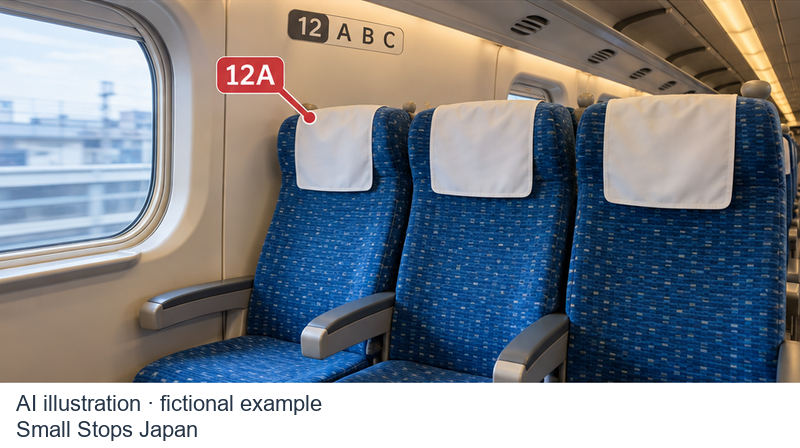
Inside car 6, find row 12, then seat A. The number identifies the row; the letter distinguishes seats across it. A row number alone is not enough to identify your seat.
For the N700-series/N700A ordinary-class layout used here, JR Central’s car 6 seat map shows three seats labelled A–B–C on one side of the aisle and two, D–E, on the other. A is by the window on the three-seat side; B is the middle seat and C is by the aisle. The illustration shows that three-seat side, with an added pointer to 12A.
Seat 12A can also exist in another carriage, so check both car and seat. Other train types and classes have different layouts; use the seat map and signs for your own reservation.
Follow the numbers as the search gets smaller
- Correct train, then track 15: find where it departs.
- Car 6: find your carriage along that train.
- Seat 12A: find row 12 and seat A inside that carriage.
If the signs and your reservation do not seem to match, show the reservation to station staff before boarding. The useful question is not simply “Where is 6?” but “Where do I board car 6 of this train?”