A wooden doll with no arms or legs can still have a surprisingly expressive face. In Tsuchiyu Onsen, a hot-spring town in Fukushima City, kokeshi are part of the streetscape as well as something you can take home. Look at one, watch how its face is painted, and the town’s familiar souvenir becomes a small introduction to local craft.
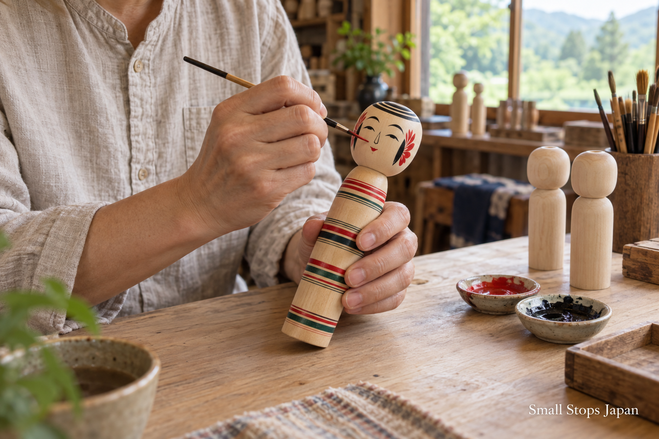
First, meet a Tsuchiyu kokeshi
Kokeshi are wooden dolls associated with northern Japan. Tsuchiyu has its own tradition within that wider family. A typical Tsuchiyu doll has a slender body, a relatively small head and bands of colour circling the wood. The black rings on the crown are called janome, a concentric-circle pattern. These features help you recognise the style; individual makers’ faces and patterns still differ. The local tourism association explains the craft.
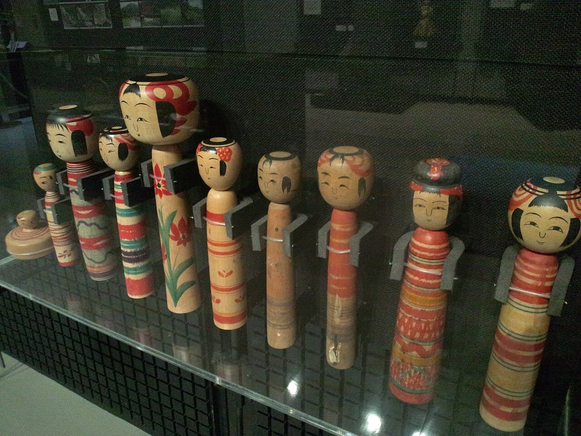
Instead of trying to memorise every detail, look at the whole expression. Are the eyes narrow or rounded? Does the mouth seem to smile? Compare the dolls below: the repeating silhouette gives them a family resemblance, while the painted faces give each one a different presence.

Why the painted lines go all the way round
The neat rings are connected to how the doll is made. The craftsperson shapes the wood on a rotating lathe, then uses that rotation to paint bands around the body. The face needs a different kind of attention: small brush marks for the hair, eyes, nose and mouth.
There is patience before the colourful stage, too. The association describes wood being left to dry naturally for nearly a year before it is shaped. That is one reason to see the finished doll as woodwork and painting together, rather than just a painted ornament. This describes the traditional process presented by the association, not a fixed production time for every doll on sale.
Find the doll in the town around you
At street scale, the same long body and small face become a welcoming landmark. Giant kokeshi stand by the Arakawa-Ohashi Bridge, near the Kajika-no-Yu footbath. JNTO’s footbath guide places them in a walking route through the hot-spring town.
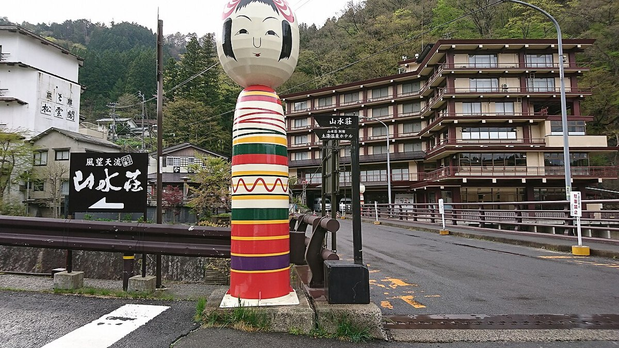

That change of scale is part of the fun: first notice a doll above the bridge railing, then look for a version small enough to hold. A shop or workshop becomes easier to approach when you already recognise what it makes. You can enjoy looking even if you are not planning to collect anything.
Paint one, or choose one to live with
The town’s official guide lists painting experiences at Matsuya and the Tsuchiyu Onsen tourism exchange centre, Yume Butai. It also asks visitors to contact craftspeople beforehand if they want to meet them. A painting session and watching a maker at work are different activities, so confirm which is available. Use the current workshop information to enquire.
For a session, ask about the doll size, total price, booking requirement and language support. A simple question is: “Can I paint a kokeshi here?” Do not assume that every shop offers the activity or can accept visitors without a booking.
If you buy a finished doll, ask before handling it and follow the maker’s care advice. At home, imagine where you would enjoy seeing its face: beside books, on a small shelf or near a favourite cup. Choose a spot where its expression will catch your eye.
A small doll offers several ways into Tsuchiyu: something to recognise on a walk, a craft to try, or a face to remember the town by. For the town’s wider setting, see JNTO’s introduction to Tsuchiyu Onsen.