You have closed your umbrella and reached the door. Does it come inside with you, or stay beside the entrance? An umbrella stand can be a useful clue, but the facility’s own instructions give you the answer. A long umbrella and a small folding one may have different destinations.
In Japanese, an umbrella stand is called a kasatate (傘立て). The object may be familiar already. What deserves a moment of attention is how this particular entrance asks you to use it.
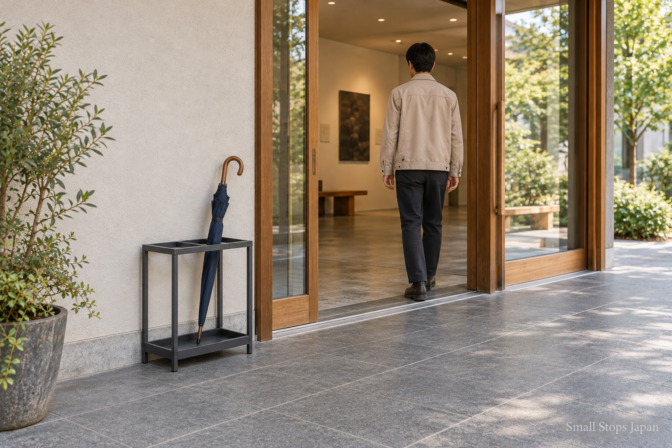
First, find the place meant for your umbrella
Look for an entrance notice or ask staff where your umbrella belongs. A rack beside a door does not, by itself, tell you the rules for every umbrella or every room beyond it. If the arrangement is unclear, a short question is enough: “Kasa wa doko ni okimasu ka?” — “Where should I put my umbrella?”
For a concrete example, Kyoto National Museum’s visitor guidance describes locked umbrella stands at the entrance. It says small folding umbrellas should be carried folded inside a bag or placed in a locker. Its Japanese guidance also explicitly includes parasols in the umbrellas to leave at the entrance. This is the museum’s policy, not a rule for every building in Japan.
Follow the umbrella down to its resting point
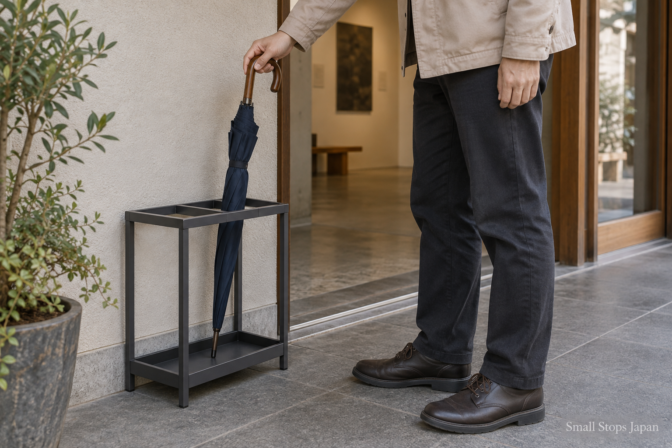
The open rack in our illustrations is a simpler, fictional example, not the museum’s locked system. The close view below follows one closed long umbrella from the hand holding its handle to the tip reaching the tray. The person still has hold of it: this picture shows placement in progress, not an umbrella balancing without support.
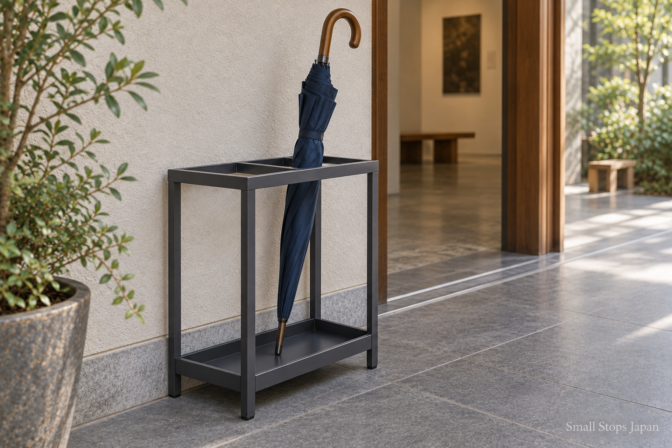
Now look at the rack without the hand. The umbrella’s tip rests on the tray, while the upper part leans against the top frame. Those two places explain its position more clearly than the handle alone. This is one arrangement; other stands have different openings and supports.
A real product offers another example of support: Yamazaki’s nine-compartment umbrella stand describes intersecting dividers that hold umbrellas in place. That description belongs to that product. It does not identify the illustrated rack or the equipment at the museum.
A folding umbrella may belong in your bag
A compact umbrella does not necessarily follow a long umbrella into the same rack. At Kyoto National Museum, the stated alternatives are a bag or a locker. The separate illustration below shows the size relationship: a folded umbrella passes through a bag’s opening, rather than standing upright in a rack.
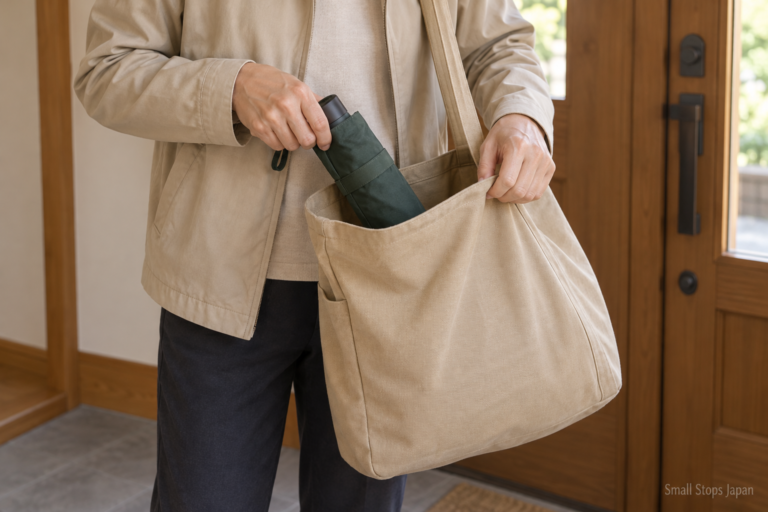
If your umbrella is wet, do not assume that folding it or slipping it into a fabric sleeve will keep the rest of your bag dry. Check the facility’s instructions or ask staff about suitable storage.
Take your cue from this entrance
The useful distinction is small: a place for long umbrellas may be provided, while folding umbrellas have a different instruction. Notice the stand, read the sign, and check where your own umbrella should go. There is no need to memorize a single rule for every doorway.
All four images are original AI-generated illustrations by Small Stops Japan. They explain fictional examples, rather than documenting a visit or demonstrating a product.