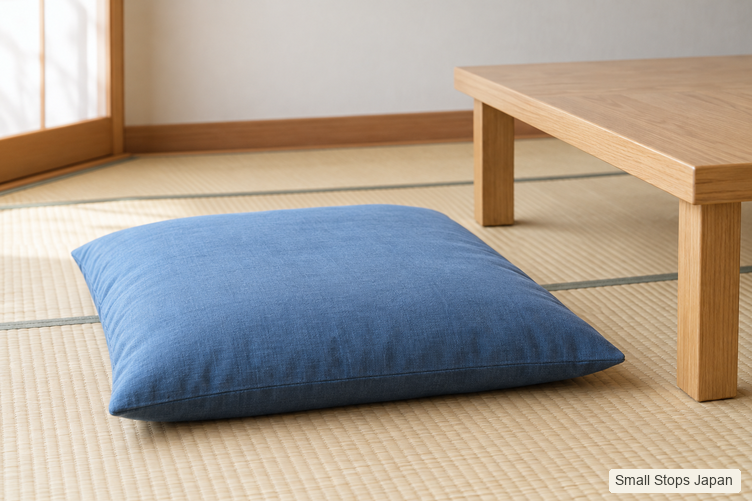
A low wooden table stands on a tatami floor. Beside it is a blue cushion, with no chair underneath. Where do you sit? On the cushion, close to the floor. It is called a zabuton (座布団), a Japanese floor cushion.
The empty place makes the arrangement easy to read. Once someone sits down, much of the cushion disappears beneath them. These illustrations show both views, so you can recognize the small object between the person and the floor.
Three separate parts: floor, cushion, table
Start at the bottom of the scene. The straw-colored tatami forms the floor surface. The blue zabuton is a separate padded object resting directly on it. The wooden table stands on its own legs beside the cushion.
The cushion is the sitting place. It has neither a raised seat frame nor a backrest, so the person remains close to floor level. The table provides a surface above that sitting place. Looking at these three parts separately is more useful than treating the whole setting as a single piece of furniture.
The edge reveals what the top can hide
In the first illustration, follow the front edge of the cushion. You can see a seam, a lower surface against the tatami, and a gently fuller middle. Those details distinguish a padded seat from a thin mat spread on the floor.
There are real differences in how zabuton are made. For one documented example, Kyoto maker Takaokaya describes its Kyoto zabuton as rounded on top and flatter underneath, with extra filling in the center where weight rests. That is the maker’s description of its own cushions, not a construction specification for these illustrations. Read Takaokaya’s Kyoto zabuton guide.
What is still visible when someone sits down?
In the second illustration, the adult sits on the blue cushion rather than directly on the tatami. Most of its upper surface is covered, but the front and side edges remain visible. Trace those edges and you can still see where the padded seat ends and the floor begins.
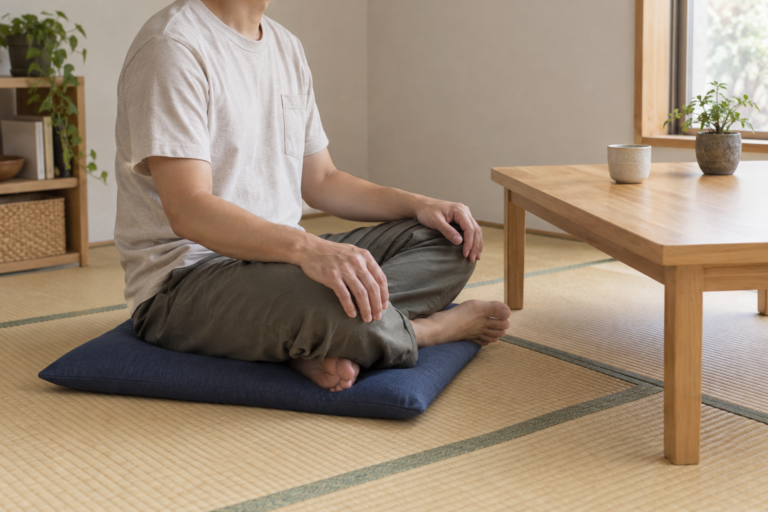
The crossed legs show one possible sitting position, not a rule for using a zabuton. The two images depict separate fictional scenes; they are not a measured before-and-after test of how one cushion compresses.
Next time you notice cushions beside a low table, look for the floor beneath, the padded seat, and the tabletop above. Then look for the small strip of cushion still visible beneath a seated person. That edge is often enough to make the whole arrangement clear.
Images: AI-generated illustrations by Small Stops Japan. Image-use notes.