After the desks have been moved aside, look down. Among the brooms and dustpans in a Japanese classroom, you may notice a small cloth being used directly by hand. That cleaning cloth is a zokin (ぞうきん, also written 雑巾).
The idea of wiping a floor with a cloth will be familiar to many readers. What is interesting here is how this ordinary object fits into a school scene: a cloth becomes a pad under a hand, then needs somewhere to go when the work is finished. The AI illustrations show fictional demonstrations, not a particular school or product.
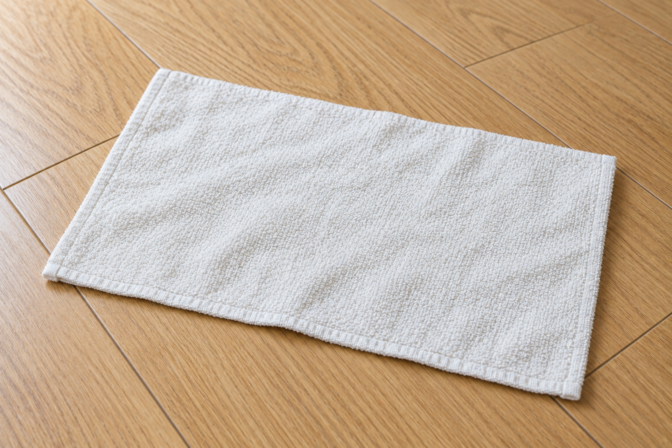
A cleaning cloth, rather than a school-only object
A zokin is not restricted to classrooms. For one concrete product example, cleaning-equipment maker Teramoto lists a cotton towel cloth for settings including schools, workplaces and homes. Its size is approximately 20 × 30 cm; that is one product’s specification, not a standard for every zokin.
Our illustrated cloth has a looped towel texture and a stitched edge. Its appearance alone would not tell you whether someone intended it for a floor, a table or another surface. In these scenes, it has been assigned to floor cleaning. That role separates it from a kitchen cloth assigned to drying dishes.
What changes when the cloth is folded?
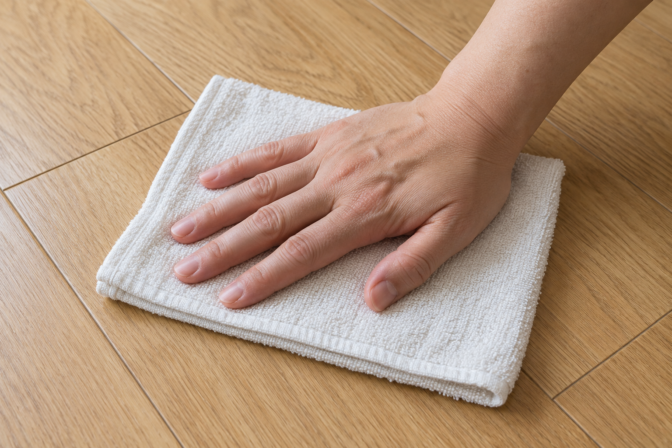
Look at the edge beyond the fingertips. The fabric continues underneath the hand, with two layers visible along the near edge. The hand presses on the upper surface; the underside rests against the floor. Folding has turned the cloth into a smaller pad that fits beneath the hand.
This is an observation of the contact, rather than a prescribed posture or direction of travel. Hirado Elementary School in Yokohama described an approach using a cloth folded in half and held with one hand in a school report updated in September 2023. It is a specific school’s example, not a rule for all Japanese classrooms.
One tool within a shared task
In The Japan Forum’s earlier school-life feature, pupils move desks, sweep and then wipe the floor with zokin. The cloth is part of that sequence, rather than the only tool doing every job.
Web Japan’s classroom-duties feature also shows how cleaning tasks are shared and explains that duties differ between schools. Neither example tells us what every school does today.
After the floor, a place to hang
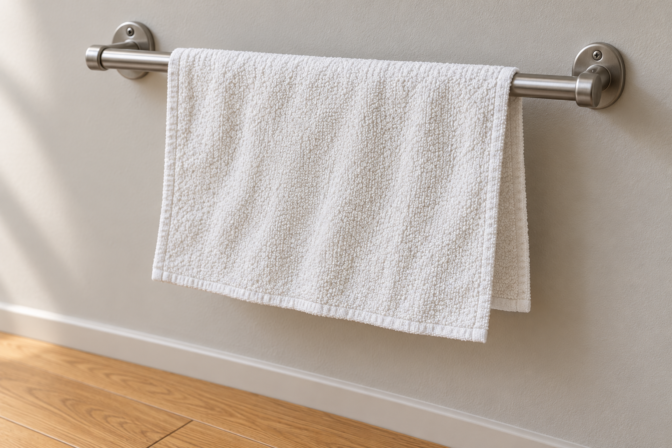
The final scene follows the same plain cloth to a rail. The fabric folds over its support and hangs clear of the floor. Dedicated equipment exists for this small job: Teramoto’s zokin-rack range is described as a place to hang towels and cleaning cloths. Our simple rail is an illustration, not that manufacturer’s rack.
The picture does not establish how a cloth was washed, how long it takes to dry or a school’s cleaning rules. Those depend on the cloth and the setting. It shows something easier to overlook: the tool still needs a place after the floor has been wiped.
A small piece of fabric can tell a larger story when you notice what it touches and where it goes next. Here, the hand, the floor and the hanging place give the zokin its context.
Sources checked on 15 October 2026. AI illustrations: Small Stops Japan. The illustrations are general examples and do not document a school visit. Image-use notes.