That handle sticking out to the side can make a Japanese teapot look a little puzzling. Where do you hold it? What keeps the leaves out of your cup? And does making tea with it require learning a whole set of rules?
This is a kyusu, a teapot for brewing loose tea. Here, we’ll follow the familiar side-handle style from dry leaves to a cup at the table. A useful place to begin is simply recognising what your hands need to do.
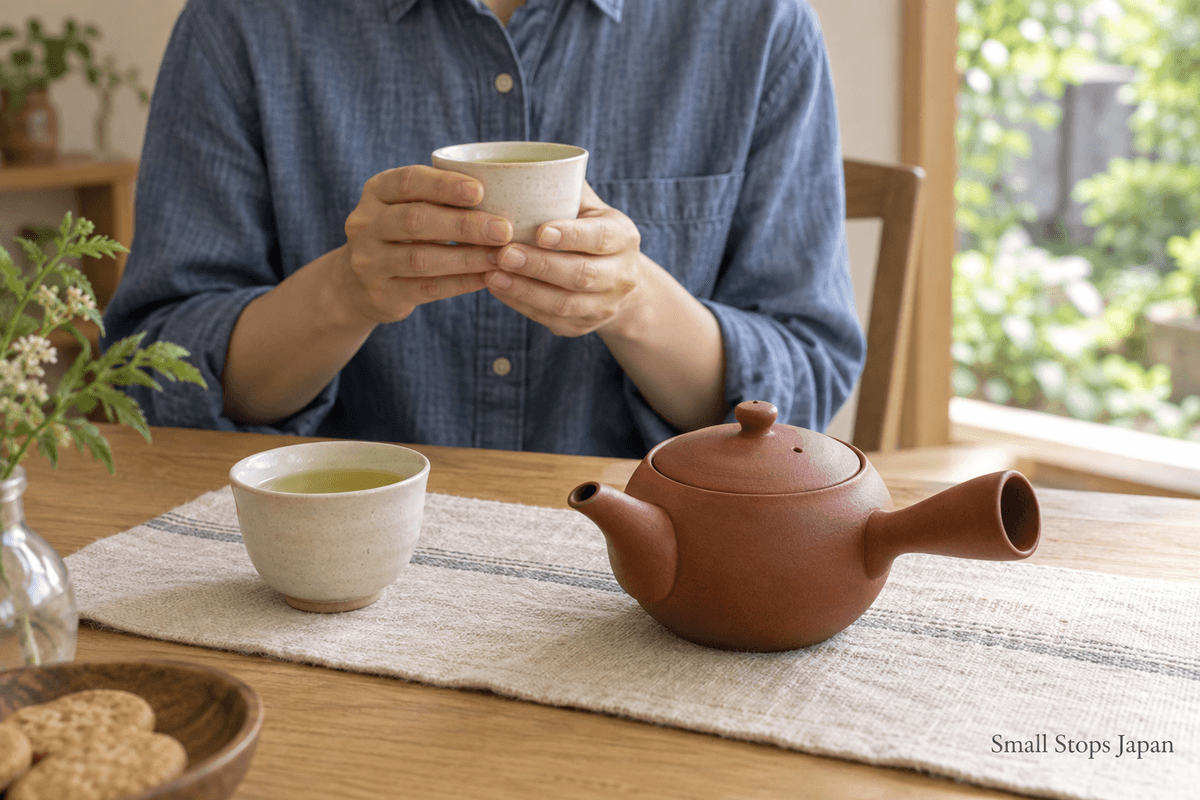
How the handle, lid and strainer work
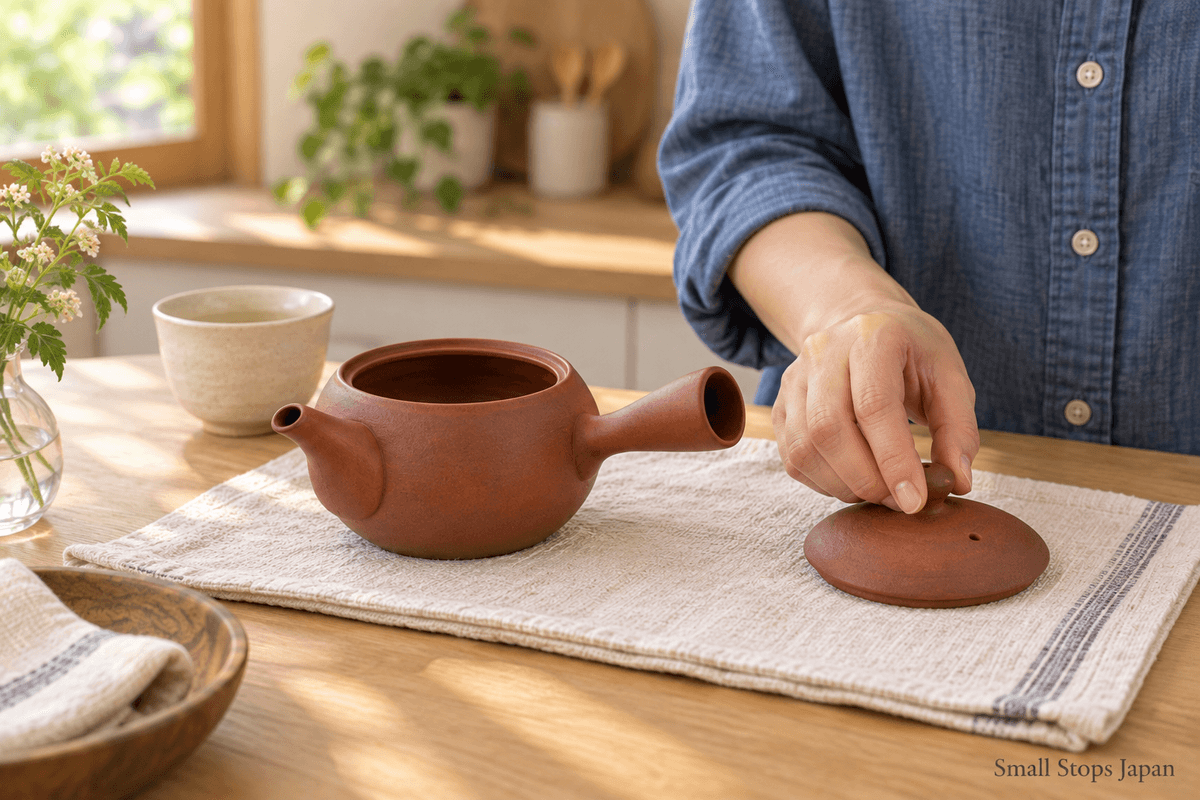
The handle gives you somewhere to grip while you tilt the pot; the lid stays on during pouring. Inside, a strainer helps keep the leaves behind. Depending on the pot, that may be a built-in ceramic filter or a metal strainer. You don’t need to memorise every variation to recognise the idea: brew in the pot, then pour the tea into a cup. Tokoname’s official kyusu guide shows several filter designs.
For this method, heat the water in a kettle and use the kyusu for steeping. Don’t put a teapot on the stove unless its maker explicitly says it is suitable. A brewing pot and a water-boiling kettle have different jobs here.
Add the leaves and check the brewing instructions
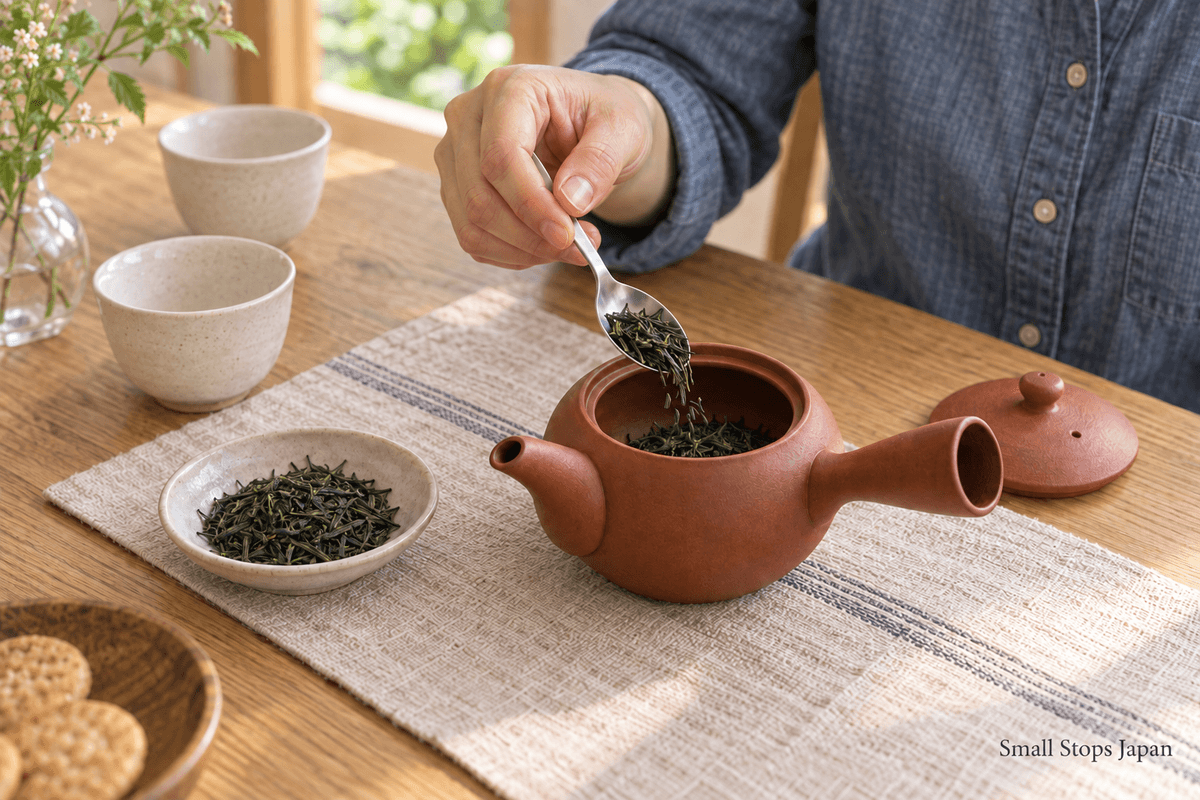
We’re using sencha, a loose-leaf Japanese green tea, as the example. The dry leaves go into the pot. They aren’t matcha powder, and you aren’t whisking them into the water.
Set out the pot, its lid, tea leaves and cups before adding hot water. Leave room in the pot for both the water and the leaves. A small cup or an ordinary mug can receive the finished tea; there’s no need to buy a complete matching set to begin.
Temperature and timing depend on the tea. Ippodo’s standard sencha recipe, for example, uses 10 g of leaves, 210 mL of water at 80°C, and 60 seconds. Ippodo describes this as a concentrated brew. Treat it as one named example, rather than a rule for every green tea.
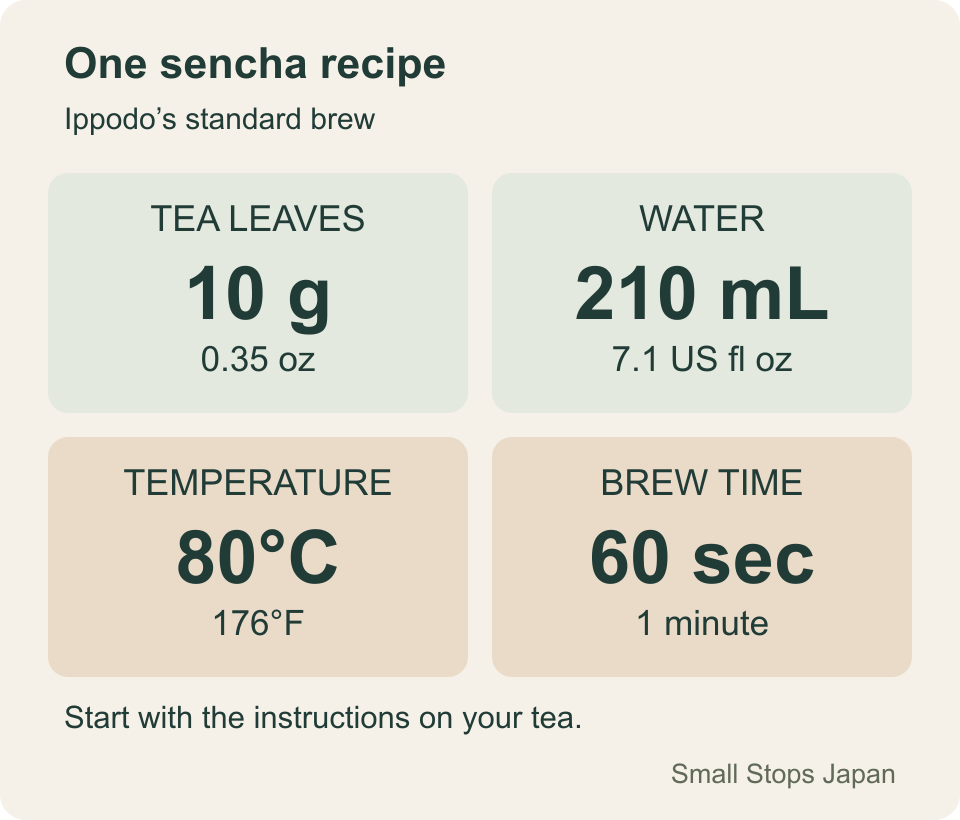
In US units, that is about 0.35 oz of leaves and 7.1 US fl oz of water at 176°F. The water quantity is for the whole batch. It can be divided between small cups; it is not 210 mL for each person.
I can’t keep every temperature and timing in my head. Starting with the instructions on the packet seems much more manageable than trying to remember them all.
Add water, then give it a moment
For the Ippodo example, add the water at the stated temperature, put the lid on and wait for the minute to pass without stirring the leaves. A timer is useful. You don’t have to watch the clock the whole time.
ITO EN’s guide shows another useful part of the process: hot water goes into the cups before it enters the kyusu. This warms the cups while cooling the water. The actual temperature depends on your water and vessels, so use a thermometer if you want to follow a particular temperature closely.
Hold the handle, steady the lid, pour gently
Keep the cup on a stable table. Grip the kyusu’s handle and use your other hand to steady the lid at its knob, taking care around hot surfaces. Tilt gradually so the spout sends a controlled stream into the cup. This two-handed approach makes the two jobs easy to see: one hand controls the pot, the other keeps the lid in place.
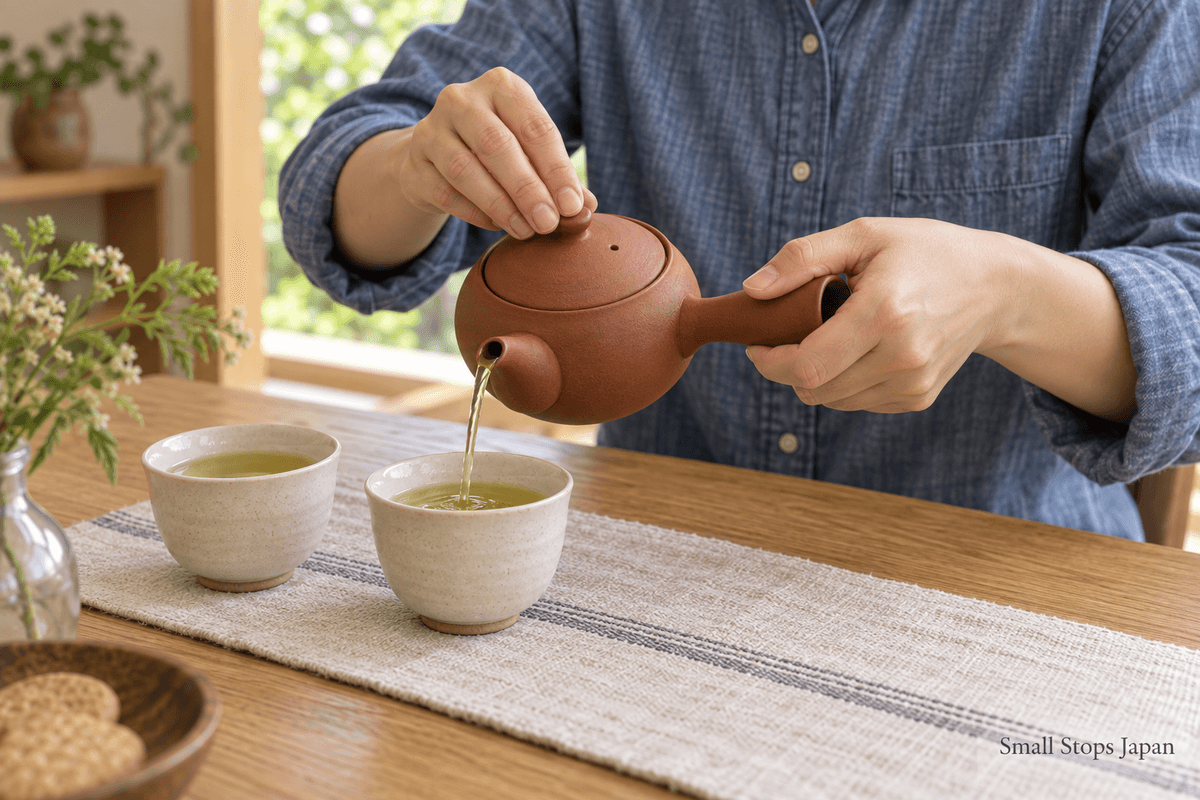
When sharing between cups, pour a little into each, then go back between them. ITO EN recommends dividing the tea evenly in small amounts and pouring out the last drops. You’re sharing one batch, rather than filling the first cup completely and leaving the rest for the next person.
Once the tea is poured, let it cool enough to drink comfortably. A handleless cup can get hot too. If you’re using one, our guide to holding a yunomi teacup shows where to place your hands. The point of this little pause is to enjoy the tea, not to rush through the movements.
Clear away the leaves, then let the pot dry
When you’ve finished with the leaves, empty them out and rinse the pot. Ippodo’s care advice recommends water, followed by wiping and drying. Leave the lid off so the inside can dry as well. Check your own pot’s care instructions before using detergent or putting it in a dishwasher; materials and finishes differ.
A Fukushima connection to look for
If you’re curious about teaware while exploring Fukushima, Jurakuen in Fukushima City’s Iizaka area lists tea and kyusu among its offerings. Elsewhere in Fukushima Prefecture, the Nihonmatsu Products Association introduces Inoue Kiln and its handmade kyusu. These are local places to begin looking; the plain pot in our illustrations is not one of their products.
Knowing how the pot is used gives you something to notice when you see one on a shop shelf: where the handle sits, how the lid fits and how it might feel at your own table. Check with the shop for current stock before making a special trip.
And if a busy day calls for a tea bag instead, that’s fine. I don’t always have time to do things the careful way either. Learning one small thing about a kyusu is already a good start.
For a different tea or setup next time, our guide to choosing Japanese tea and teaware brings together the tea, the brewing vessel and the drinking cup.