Picture a bowl of rice with chicken and egg spread across the top. You hear the word donburi. Does it name the meal, or the bowl holding it?
It can name either. The useful clue is what the speaker is describing: an object to put food in, or a dish to eat. Following one meal—oyakodon, chicken and egg over rice—makes the difference easier to see.
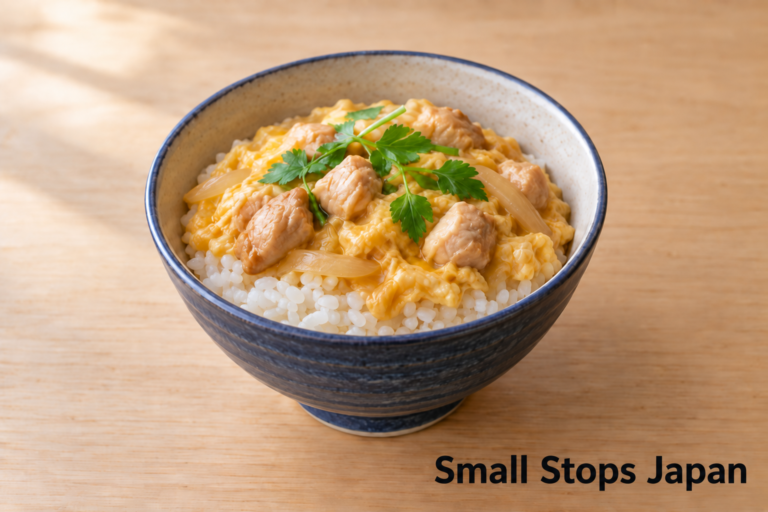
Start with the empty bowl
Kanjipedia, the dictionary provided by the Japan Kanji Aptitude Testing Foundation, gives two relevant meanings for 丼 (donburi): a deep ceramic bowl, and a dish of rice with ingredients placed on top in such a bowl. The container and its contents share a name.
An empty bowl lets you look at the space that food will occupy. Follow the rim, then the sides down toward the base. When you are deciding where to serve rice and a topping, both need room inside. Looking at that space is more useful than trying to find a diameter at which an ordinary rice bowl becomes a donburi. The dictionary entry supplies no such measurement.
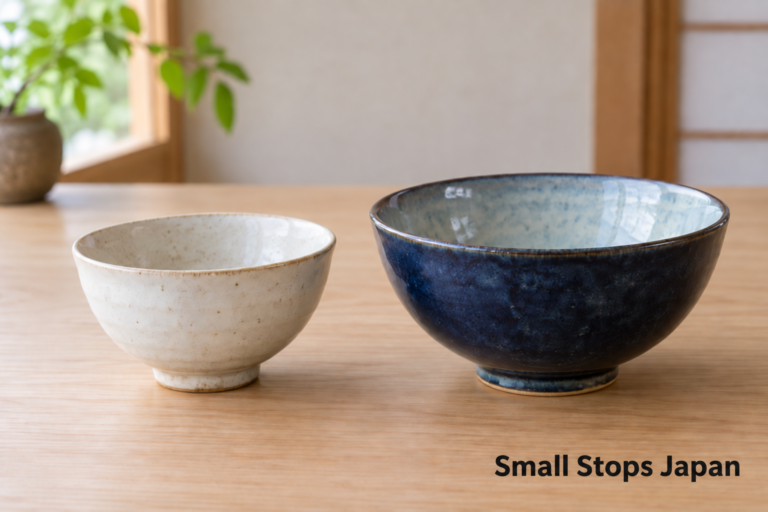
Nor does a bowl’s name tell you that it must contain rice. NARUMI, for example, calls one of its products a 麺丼, or noodle bowl. This is an example of a maker’s vessel name, rather than a definition of every donburi. In a shop, the word may lead you to an empty object; in a food description, it may lead you to a meal.
Now put the rice and topping together
For the food meaning, look at oyakodon. Japan’s Ministry of Agriculture, Forestry and Fisheries describes chicken and onion cooked with egg and served over white rice. Its account also notes variations, so onion is part of this example, not a requirement for every version.
The important relationship here is the topping over the rice. A view of the chicken and egg alone could hide half the explanation. Seeing rice at the edge, or beneath an opening in the topping, shows how both parts occupy one bowl.
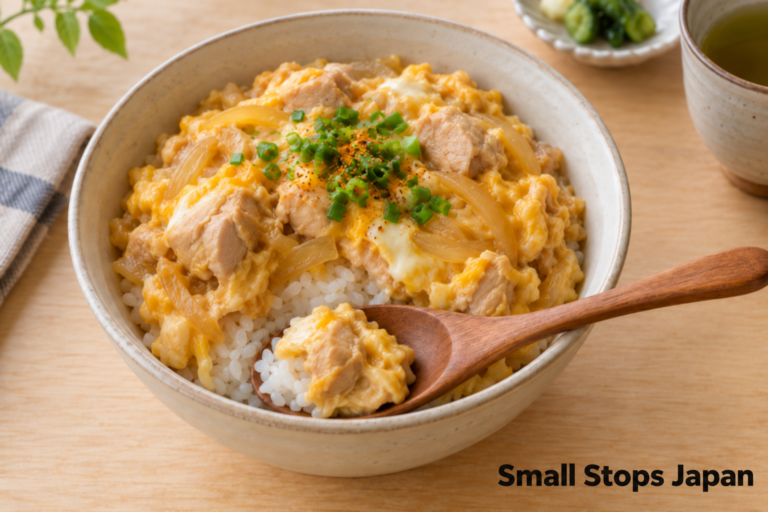
The word oyakodon names the prepared dish. It does not tell you the bowl’s colour, pattern or exact size. Reading the food description supplies the missing information: what has been put with the rice. Knowing the vessel name alone cannot do that.
A meal can also spread across separate dishes
Picture a different meal: plain rice in a bowl, grilled fish on a plate, and greens in a small side-dish bowl. The rice and other foods each have their own place. This is a separate serving example, not the oyakodon rearranged into several dishes.
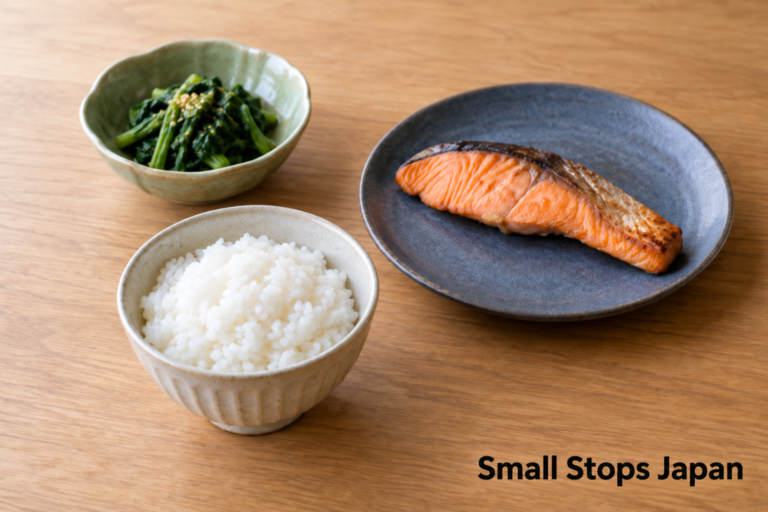
MAFF’s introduction to Japanese tableware describes using different vessels for different foods, including rice bowls, plates and smaller bowls. That gives us another way to look at the table: which foods share a vessel, and which are kept apart?
The comparison is about placement, not equal portions or nutritional value. Our kobachi article follows the small side-dish bowl more closely. Here, it helps make the contrast visible: the side dish has its own container, while the chicken and egg in oyakodon sit with the rice.
Read the setting as well as the word
Next time you meet donburi, look for two clues. Are you choosing an empty vessel, or reading about food? If it is food, what sits with the rice?
At home, you can ask a related question before setting out the dishes: will the topping go over the rice, or will you serve the foods separately? That decision gives the bowl a job. Its name is a starting point; its shape and the meal you put inside make the rest of the picture.