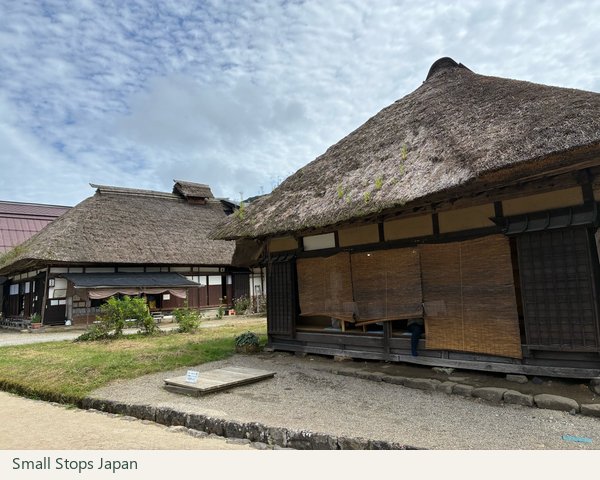
The broad thatched roofs may be what first draws you to Ouchi-juku. At street level, though, smaller details offer different reasons to pause: a long green onion resting across a soba bowl, a café’s stepped wooden drawers, or the thick edge of a roof above a rolled-down blind.
Ouchi-juku is a former post town in Shimogo, Fukushima Prefecture. These photographs from my visit suggest three ways to enjoy it: stop for a meal, take a café break, or look more closely at the buildings. Each offers a different starting point. Choose the detail that interests you.
For a meal, look at the long negi at Komeya
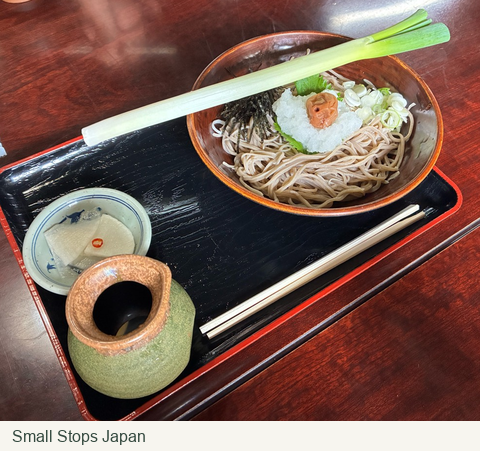
At Komeya, the first thing to notice in this photograph is the length of the negi, a Japanese long green onion. It reaches beyond the bowl on both sides. Beside it, the chopsticks lie along the edge of the black tray: two very different shapes sharing the setting of one meal.
Soba are buckwheat noodles. Shimogo Town lists Komeya, written こめや, among Ouchi-juku’s places serving negi soba. The long onion is part of the dish’s appeal, and can be used to lift noodles as well as eaten. The chopsticks in the photograph are a useful reminder that the meal also comes with familiar utensils. Shimogo Town’s restaurant list identifies the shop and its speciality.
If food is what draws you into a place, this is a concrete starting point: look for the shop’s name, then explore the bowl and the onion together. For a closer view of how the onion meets the noodles, see our Komeya photo story, which includes a second photograph of the action.
For a café break, notice Bunke Tamaya’s wooden interior
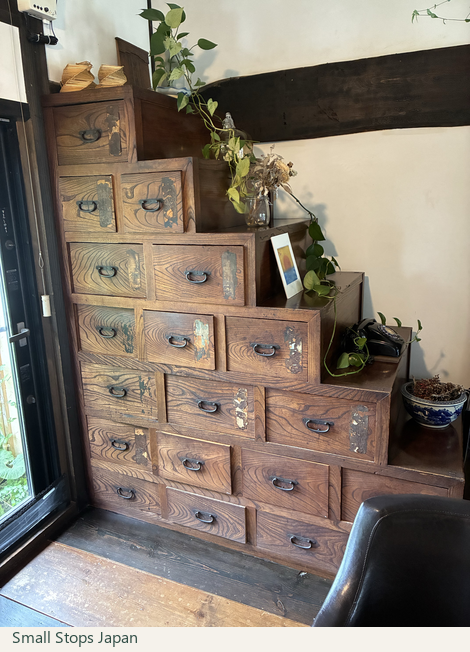
Bunke Tamaya, written 分家玉や, is an atmospheric café. One detail that helps explain its appeal is this stepped arrangement of wooden drawers.
Follow the outline from the high left side down towards the right. Drawer fronts fill the vertical faces, while plants, a framed picture and a black telephone occupy some of the horizontal surfaces. Above them, a dark timber beam runs across the pale wall. The interest is in the whole corner: furniture, objects and the room’s structure work together.
The café’s official information currently says it does not serve lunch or other meal menus. Think of it as a café break, rather than assuming it can replace your lunch stop. There is also a separately listed business called Honke Tamaya, 本家玉屋; keeping the full name Bunke Tamaya in mind helps distinguish the café.
If this corner catches your attention, our photographs of the storage furniture at Bunke Tamaya let you look more closely.
For the buildings, look from the roof down to the frontage
Return to the opening photograph and follow the nearest roof down to its edge. The thatch forms a thick, textured layer above the darker wood. Below it, broad blinds hang in front of the building. The neighbouring roof repeats the sloping outline at a different distance, so the photograph gives you both a close surface and part of the wider setting.
That change of scale is a simple way to look around: first take in the roof shapes, then choose one frontage and notice how its roof, timber and blinds meet. You do not need to identify every building to find something worth a closer look.
The town’s heritage account explains that Ouchi-juku developed as a stopping place on an Edo-period route and was selected as an Important Preservation District for Groups of Traditional Buildings in 1981. It also describes residents learning thatching skills and maintaining sources of roofing material. The surviving appearance is supported by continuing care. Read the town’s account of the district and its preservation.
For the material and maintenance behind those roof shapes, continue to our closer look at Ouchi-juku’s thatched roofs.
Choose the pause that suits your curiosity
A bowl of noodles gives you a food detail to explore. A café corner brings the wooden interior closer. Looking from roof to frontage helps you see more in the streetscape. Each can be a starting point, whether you are planning a visit or simply enjoying the photographs.
Before visiting, check the businesses’ current opening information. Bunke Tamaya’s official page directs visitors to its Instagram for detailed opening days; the photographs here record the visit, not today’s opening status.
Photographs: Small Stops Japan. About our images.